


Chasing Authentic Bun Bo Hue: A Local's Map to the Real Thing
📋 Table of Contents
[!NOTE] Pricing Note for International Tourists The prices listed are inclusive of a 20% tax and service fee applied to foreign tourists. Estimated USD rates are based on current exchange rates and may slightly vary.
When a Bowl of Bun Bo Hue is More Than Just Soup — It’s the Soul of the Ancient Capital
I still vividly remember the first misty morning I set foot in Hue over a decade ago. Before even checking into the hotel, before washing my face, a local friend dragged me straight into a small alley near Dong Ba Market. I sat down on a low plastic stool, and a steaming bowl of Bun Bo Hue was placed before me. The aroma of lemongrass, shrimp paste, and simmered bones mingled in the early morning air — I knew I was captivated by Hue from that moment on. If you’re planning to seek out the most authentic, original Bun Bo Hue in the ancient capital, then this article is the map you need — not the kind of pre-printed tourist map sold at souvenir stalls, but the kind only obtained after eating dozens of bowls at numerous eateries, and asking countless Hue housewives.
Bun Bo Hue — Not “Central Vietnamese Pho,” And Never Call It That
Before embarking on your quest for the best bowl of Bun Bo Hue, you need to understand one thing: Bun Bo Hue is a completely independent entity, with a deep history, culinary philosophy, and distinct cooking techniques that no other dish in Vietnam can replace. Hue people are very proud of this, and for good reason.
The Royal Origins of a Humble Bowl
Bun Bo Hue’s history is intertwined with the imperial city of Hue from the time of the Nguyen Lords, and it flourished under the Nguyen Dynasty (1802–1945). What’s fascinating is that this dish bears the imprint of the royal court while also being entirely part of everyday life — a combination that could only have originated in Hue.
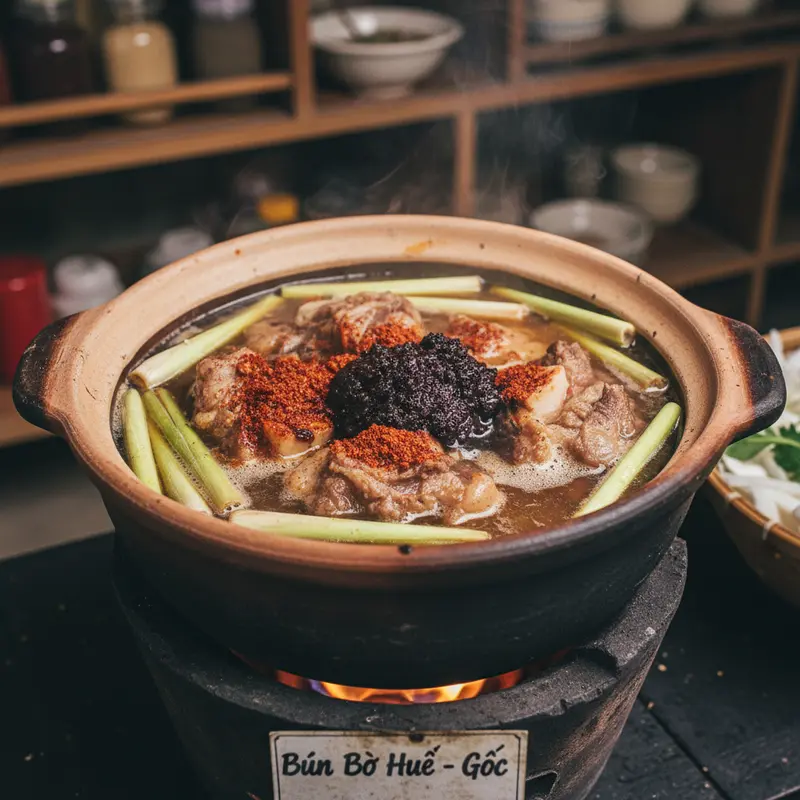
According to Hue culinary researchers like Ms. Ton Nu Thi Ha (granddaughter of a Nguyen Dynasty official), the original Bun Bo Hue broth is simmered from beef leg bones combined with pork bones for a minimum of 6 to 8 hours, not the 2-3 hours many modern eateries cut corners with. Hue shrimp paste — made from small sea shrimp, salt, and fermented according to a specific process — is the irreplaceable “soul” of the dish. Without shrimp paste, a bowl of Bun Bo Hue is just ordinary beef soup.
Lemongrass is the third ingredient that forms the decisive flavor trio: simmered bones + shrimp paste + lemongrass. Lemongrass must be bruised, stir-fried with annatto oil to create the characteristic reddish-orange color before being added to the broth. Hue chili powder — a coarse ground dried chili, not fresh chili — also plays a crucial role in creating the unique spicy kick that Bun Bo Hue in other provinces can never achieve.
The “Original” Toppings That Many Eateries Outside Hue Have Omitted
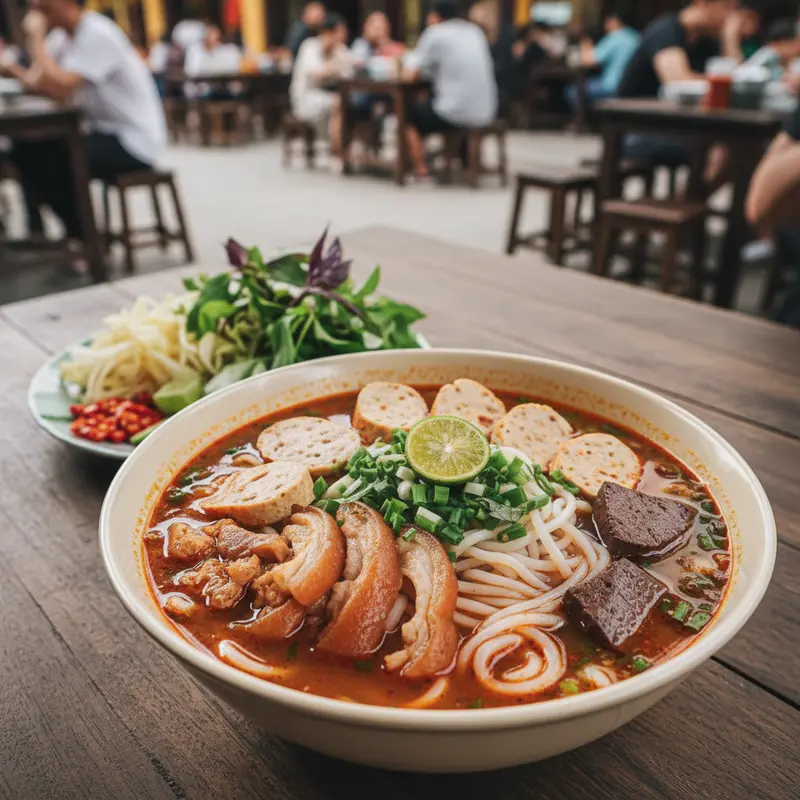
A truly authentic bowl of Bun Bo Hue must include:
- Sliced beef shank (not fresh beef slices like in pho)
- Pork knuckle (tender simmered pork trotter slices, not mushy)
- Hue crab cake — this is the biggest difference. Real crab cake is made from crab roe, not imitation fish cake or pork cake.
- Pork blood pudding cut into cubes, simmered just to the right firmness
- Thick rice vermicelli — not thin vermicelli like Southern Vietnamese Bun Bo
The accompanying herbs are also different: shredded banana blossom, blanched bean sprouts (not raw), shredded water spinach, basil, and especially thinly sliced shallots pickled in vinegar — something many Bun Bo Hue eateries in Saigon or Hanoi often overlook.
[!NOTE] Hue people eat Bun Bo Hue early in the morning, from 6 AM to 9 AM. This is the golden hour to enjoy the best bowl because the broth has been simmering overnight and retains its full flavor. If you arrive after 10 AM, many popular eateries may have sold out, or the broth might be diluted from being topped up.
The Journey## Field Trip: Top Authentic Hue Beef Noodle Soup Spots I’ve Verified
I spent nearly two weeks eating beef noodle soup every morning (and sometimes in the afternoon), exploring the streets and alleys of Hue to compile this list. This isn’t a list copied from online review sites – it’s the result of early mornings, conversations with the shop owners, with locals, and of course, with many bowls of noodles.
Ba Tuyet’s Noodle Soup Shop — Alley 3 Nguyen Truong To: The Most Authentic According to Native Hue Locals
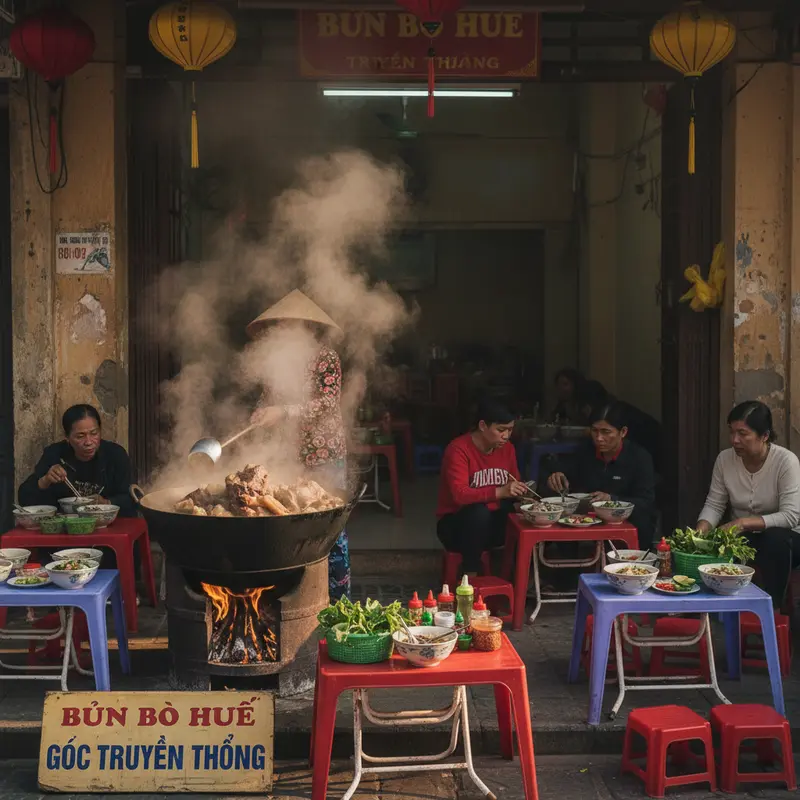
If you ask any Hue local over 50 which beef noodle soup shop is the best, 7 out of 10 will mention Ba Tuyet’s shop. The shop doesn’t have a big sign, no precise Google Maps (the online address is often a few numbers off), and no waitstaff – you bring your own bowl to your table.
What impressed me most here was the broth. It’s clear yet strangely rich – not cloudy like many other shops that deliberately overcook the bones. Ba Tuyet (who is now over 60) said she simmers the bones from 10 PM the night before, on a low heat, never letting the water boil vigorously. “If the broth boils vigorously, it’s ruined, it becomes cloudy and loses its sweetness,” she told me while ladling noodles.
The price for a special bowl here: 45,000–66,000 VND (≈$3). The shop opens at 5:30 AM and usually sells out before 9 AM. Actual address: a small alley opposite Dong Ba Market on Nguyen Truong To street, ask locals when you get close.
Mu Rot’s Noodle Soup Shop — Nguyen Du Street: A Living Culinary Heritage
“Mu Rot” is how Hue locals affectionately call the shop owner who has been selling beef noodle soup here for over 40 years. Her daughter now runs it, but the recipe and cooking method remain the same. This is one of the few shops that still uses a charcoal stove to simmer the bones – which creates a subtle, warm smoky flavor in the broth that gas stoves can never achieve.
The special feature of this shop is the crab paste made on-site every morning, not bought pre-made. Fresh crab roe is mixed with crab meat and spices, poured into molds and steamed – you can witness this process if you arrive before 6 AM. The broth here has a stronger shrimp paste flavor than other shops, suitable for those who prefer the truly “intense” Hue taste.
Price: 40,000–60,000 VND (≈$2). Open from 5 AM to 9:30 AM.
Dinh Tien Hoang Street Noodle Soup Shop No. 2: The Choice of Discerning Young Hue Foodies
This shop has no specific name; locals just refer to it by its address. This is the shop chosen as a “regular” by young Hue people – especially students from Hue University of Sciences and office workers in the surrounding area. The space is more airy, the tables and chairs are better, but importantly, the quality is no less than the older shops.
A big plus: this shop is open until 11 AM, suitable for tourists who sleep in late. They also offer vegetarian beef noodle soup on the 1st and 15th of the lunar month – a very Hue cultural practice that few tourists know about.
An Cuu Market Sidewalk Beef Noodle Soup: The Most Rustic, Most Delicious Experience
This is the choice for those who want to experience Hue beef noodle soup in the most “raw” way possible. The sidewalk area around An Cuu Market (south of the Perfume River) has about 5-6 small beef noodle soup carts, each with only 10-15 seats, selling from 5 AM until sold out (usually around 8:30 AM).
There’s no menu, no listed prices – you sit down, the owner asks “regular or special bowl,” and within 2 minutes, you have a bowl of noodles in front of you. Prices range from 30,000–48,000 VND (≈$2). It was so delicious that I returned 3 times in one week.
[!TIP] To find the best sidewalk beef noodle soup carts, observe where the motorcycles of the customers are parked.where locals park the most in the early morning. Hue people don’t eat at bad places — that’s the most reliable unwritten rule.
Decoding the Deliciousness: Why Bun Bo Hue in Hue Tastes Better Than Anywhere Else?
This is a question I’ve asked many chefs and many Hue housewives, and the answer always revolves around a few core elements that not everyone notices.
Hue Shrimp Paste — The Irreplaceable Ingredient
Hue shrimp paste is made from small shrimp (moi) caught in the waters of Thuan An and Lang Co — small shrimp with sweet bodies, salted according to a specific ratio and time. Hue shrimp paste has a characteristic pinkish-purple color, a strong but not pungent smell, and when mixed into hot broth, it creates an extremely complex layer of umami flavor.
Shrimp paste from other provinces, although also called “shrimp paste,” is made from different ingredients and processes — therefore, the taste is completely different. This is why bun bo Hue cooked in Hanoi or Saigon, no matter how hard they try, can never achieve the authentic taste.
Hue Lemongrass and Local Chili Powder
Lemongrass grown in Hue has a more concentrated essential oil content than lemongrass from other regions due to the soil conditions. Hue chili powder — especially Cam Lo chili from Quang Tri, often used in Hue — has a pungent, aromatic spiciness and a vibrant red color without the bitterness of cheap chili.
Hue Rice Noodles — Thick, Chewy, Not Mushy
The noodles used for bun bo Hue are thick strands (about 3-4mm in diameter), made from soaked and ground rice using traditional methods. Many noodle makers in Hue still grind rice with stone mills. These noodles have a natural chewiness, are not mushy, and most importantly, do not become soggy in hot broth — something that industrially produced noodles cannot achieve.
How to Travel to Hue to Eat Bun Bo: Don’t Let Travel Ruin Your Breakfast
Many tourists from Da Nang or Hoi An want to go to Hue just to eat bun bo in the morning — and that’s entirely possible if you prepare correctly.
From Da Nang to Hue
The distance from Da Nang to Hue is about 100km, passing through Hai Van Pass — one of the most beautiful routes in Vietnam. If you want to arrive in Hue at 6 AM to catch the bun bo, you need to depart from Da Nang around 4 AM–4:30 AM.
This is why I always recommend tourists use the shuttle service from Faifo Express instead of driving themselves or booking a taxi/Grab. The reasons are very practical:
- Local drivers with local knowledge: Hai Van Pass in the early morning is heavily foggy, requiring experienced drivers. Faifo Express drivers run this route daily, knowing every curve and every dangerous spot.
- Absolute safety: Vehicles are regularly maintained and have passenger insurance. No need to worry about “unfamiliar Grab motorbike taxis” at 4 AM.
- Flexible all-inclusive packages: You can book shuttle service from Da Nang airport directly to Hue, or a car from Hoi An to Hue and back in the same day — all in one booking.
- Drivers are true “guides”: Many Faifo Express drivers are Hue locals or have driven this route for years; they know which bun bo stalls are delicious, which markets are worth visiting, and the best spots for photos on Hai Van Pass.
[!WARNING] Absolutely do not book unfamiliar Grab cars or taxis to travel from Da Nang to Hue in the early morning. Besides the safety issues on Hai Van Pass in foggy conditions, there have been cases where tourists were overpriced or drivers were not on time, causing you to miss the golden hour for bun bo (before 9 AM).
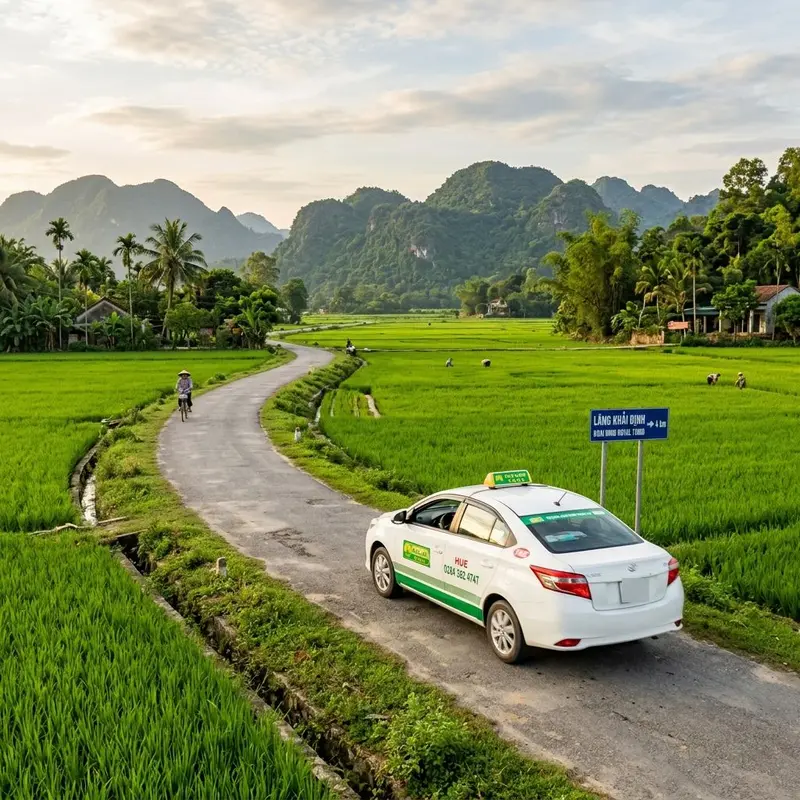
If you are in Hoi An and want to combine it with a trip to Hue, Faifo Express also offers car service from Hoi An toHue, you can visit roadside attractions like Lang Co, Hai Van Pass summit, before arriving in Hue for a midday bowl of bun bo.
If you’re staying in Hoi An and want to experience authentic Bun Bo Hue in the morning, a trip to Hue is entirely feasible — and Hoi An to Hue car rental with a local driver will help you maximize your time, arriving at the golden hour for breakfast while having the opportunity to visit beautiful stops along the way such as Lang Co or the summit of Hai Van Pass.
Getting Around Hue City
Once in Hue, delicious bun bo eateries are generally located within a 3-4km radius of the center (Dong Ba, Phu Nhuan, An Cuu areas). You can:
- Rent a bicycle: 50,000–96,000 VND (≈$4)/day. Hue is an extremely bike-friendly city—flat, not too wide, and with plenty of shade trees.
- Traditional motorbike taxi: Locals in Hue still use traditional motorbike taxis more than Grab. Prices are usually negotiated, 15,000–36,000 VND (≈$1) for short distances within the city.
- Walk: If your hotel is in the central area (near Dong Ba Market, Le Loi Street), many good bun bo places are within a 10-15 minute walk.
A Complete Experience: More Than Just Eating Bun Bo, It’s Understanding Hue Through a Bowl
Join a Bun Bo Hue Cooking Class
Some establishments in Hue offer morning cooking classes, including for Bun Bo Hue. This is a fantastic way to gain a deeper understanding of this dish. You’ll go to the morning market with the chef, select ingredients, and personally cook a pot of bun bo from scratch. The cost is around 500,000–960,000 VND (≈$37)/person, including the meal.
Visit Dong Ba Market — Where Bun Bo Ingredients Converge
Dong Ba Market opens at 4 AM, and this is where you can witness the entire supply chain of a bowl of Bun Bo Hue. Hue housewives shop for shrimp paste, lemongrass, chili powder, and beef bones here. The shrimp paste section at Dong Ba Market is particularly interesting—dozens of different types of shrimp paste, from freshly fermented to aged, with varying colors and aromas.
[!TIP] If you want to bring Hue shrimp paste home as a gift, buy it at Dong Ba Market instead of specialty stores. It’s 30-40% cheaper, and more importantly, you can choose directly from vendors familiar to locals. Shrimp paste fermented for 3-6 months has the best flavor for cooking bun bo.
A Photo Op with a Bowl of Bun Bo Hue
If you want to capture beautiful photos of your bowl of Bun Bo Hue:
- Early morning natural light (6 AM–7:30 AM) creates a beautiful warm yellow tone for food photography.
- Choose a top-down (flat lay) or 45-degree angle to clearly showcase the vibrant orange-red broth and diverse toppings.
- Ideal backgrounds: old wooden tables, vintage blue and red plastic chairs, or the patterned tile floors of old eateries.
- Don’t forget to photograph the owner ladling the noodles—these are often the most beautiful and authentic shots.
Estimated Costs for a “Bun Bo Pilgrimage” to Hue
To help you plan realistically, here’s a reference cost breakdown for a 1-day trip to Hue from Da Nang, with the primary goal of eating bun bo:
| Item | Estimated Cost |
|---|---|
| Round trip transportation Da Nang – Hue – Da Nang (Faifo Express) | Contact for quote |
| Morning Bun Bo (special bowl) | 40,000–66,000 VND (≈$3)/person |
| Additional Bun Bo (if you want to compare 2 places) | 40,000–66,000 VND (≈$3)/person |
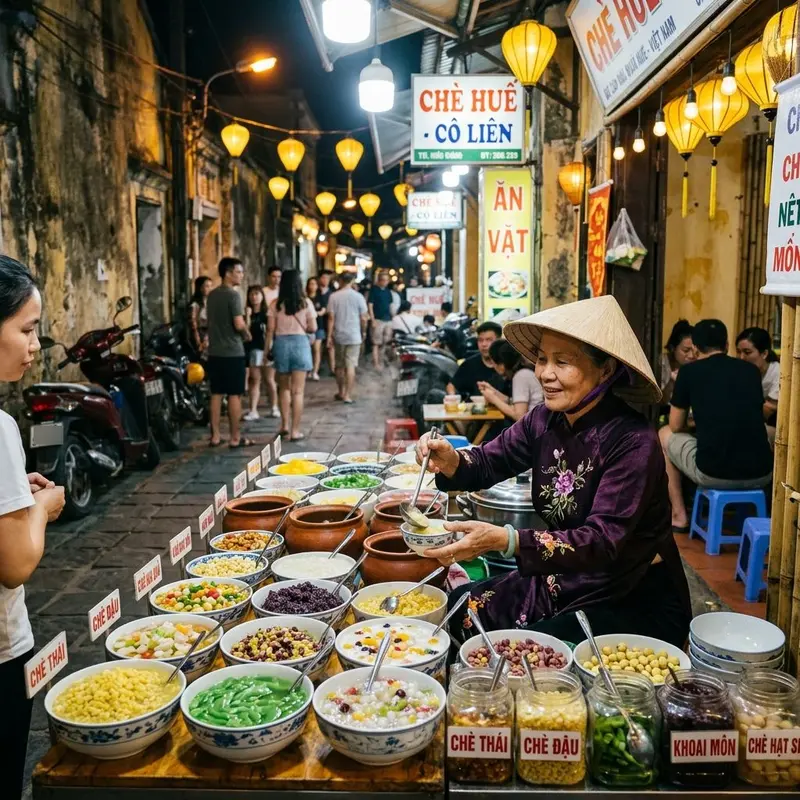
| Drinks (Hue coffee, Hue sweet soup) | 20,000–48,000 VND (≈$2) |
| Bun Bo cooking class (optional) | 500,000–960,000 VND (≈$37)/person |
| Shrimp paste, souvenirs to take home | 100,000–360,000 VND (≈$14) |
| Total (excluding cooking class) | ~1,000,000–2,040,000 VND (≈$78)/car |
Calculated out, if traveling in a group of 4, the cost per person is only about 250,000–510,000 VND (≈$20) for a memorable day of Hue culinary exploration—extremely reasonable.
Practical Tips: Things Only Those Who Have Been Know
Golden Hours and Times to Avoid
- 5:30 AM–7:30 AM: The ideal time frame. The broth is at its best,The quan is crowded but there are still seats, the morning atmosphere of Hue remains intact.
- 7:30 AM - 9:00 AM: Still okay, but the popular quan start to get more crowded, some toppings might run out (especially crab cakes).
- After 9:00 AM: Many quan start to dilute their broth or have sold out. Not recommended.
Frequently Asked Questions
Frequently asked questions about Find the Best Authentic Bun Bo Hue in Hue, Vietnam
What is the best way to use this guide to Find the Best Authentic Bun Bo Hue in Hue, Vietnam?
Is Find the Best Authentic Bun Bo Hue in Hue, Vietnam suitable for a first-time visitor?
Can I combine Find the Best Authentic Bun Bo Hue in Hue, Vietnam with other nearby plans?
What should I confirm before making plans for Find the Best Authentic Bun Bo Hue in Hue, Vietnam?
How can I avoid last-minute problems with Find the Best Authentic Bun Bo Hue in Hue, Vietnam?
Tags
The Faifo Express
This article was written by the driver and travel consultant team at Faifo Express — over 5 years of experience in travel transport across Da Nang, Hoi An, and Hue. All information is based on real experience serving 5,000+ customers every month.
Related services
Airport Transfer
Hotel pickup, all-inclusive price
View DetailsDay Tour Car Rental
Ba Na Hills, Hoi An, My Son...
View DetailsShared Car
From just 100K VND/person
View DetailsTourist Car Rental
Explore the beauty of Central Vietnam with our private tourist car service.
View Details🛣️ Popular Routes
Follow Faifo Express
Get exclusive deals, real reviews and the latest Central Vietnam travel tips.
Faifo Express
Updates, customer reviews & real trip photos.
@trm.anh.travel
Real experience videos, Da Nang – Hoi An travel tips.
@xedichvudananghoianhue
Real videos of routes, fleet and transfer services.
@xedananghoianFE
Quick news, flash deals and direct interaction.
DM us on Facebook — response within 5 minutes