


The Royal Tombs of Hue: Inside the Resting Places of Three Emperors
📋 Table of Contents
Hue and the Imperial Dreams That Endure in Stone
One morning, I stood before the gate of Minh Mang Tomb at 7 AM, as the mist had not yet fully dissipated over Trung Minh Lake. The feeling at that moment could only be described as “awe-inspiring.” It wasn’t because the structure was overly grand—though it absolutely deserved that title—but because of the sensation of stepping into an entirely different world, where time seemed to thicken, and where every brick, every row of trees, every tranquil lake surface told an unending story.
If you are planning to explore the three most beautiful tombs in Hue—Minh Mang Tomb, Tu Duc Tomb, and Khai Dinh Tomb—then this article is what you need to read before setting foot in the Ancient Capital. This isn’t the superficial “top 10 Instagrammable spots” kind of article you see all over the internet. This is the journey I took, where I sat and listened to every hidden corner of the three greatest structures of the Nguyen Dynasty, and I want to share it with you as a true travel companion.
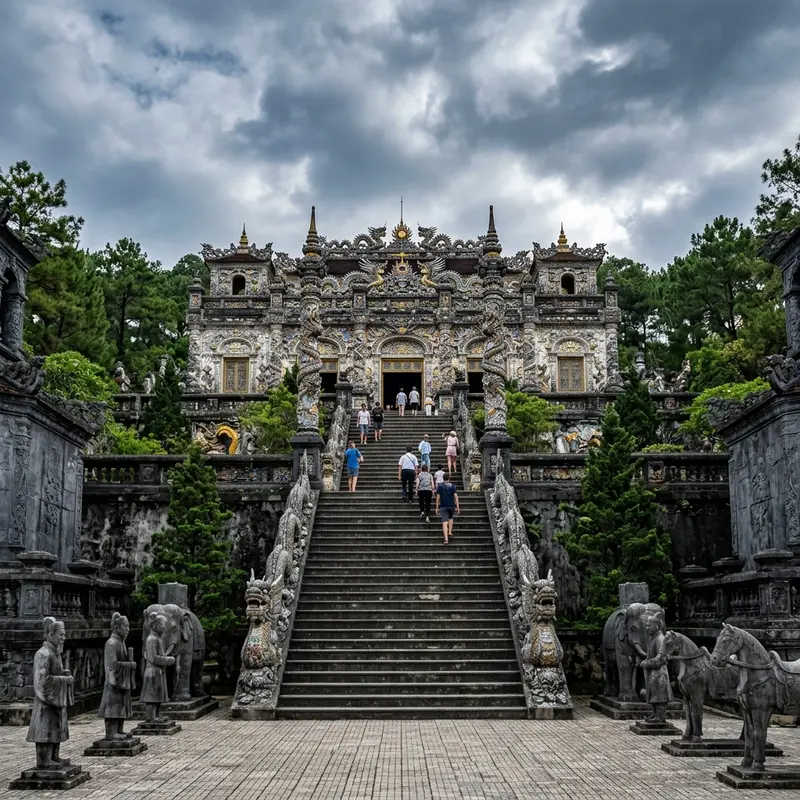
Overview: Why Are Hue Tombs Different From Any Monument You’ve Ever Seen?
Before delving into each specific tomb, I want you to understand one thing: tombs in Hue are not merely burial sites. Vietnamese people—especially the kings of the Nguyen Dynasty—considered tombs to be “palaces after death,” where the soul would continue to reign in the afterlife. Therefore, each tomb was built as a miniature kingdom, complete with a triple-arched gate, a lake, gardens, temples, a stele pavilion, and the buu thanh—the burial chamber where the emperor’s coffin was placed.
What’s fascinating is that no two tombs in Hue are alike. Each king had his own personality, his own philosophy of life, and this is clearly reflected in the architecture of their tombs. Minh Mang Tomb is solemn and symmetrical, like a classical piece of music. Tu Duc Tomb is poetic and picturesque, like a Tang Dynasty poem. Khai Dinh Tomb, on the other hand, is unconventional and bold, like an abstract painting rendered with thousands of porcelain shards.
Three styles, three souls, one Hue.
[!NOTE] All three tombs are located southwest of Hue city, 5 to 16 km from the center, upstream along the Perfume River. You can visit all three in one day if you start early and plan your travel efficiently.
Minh Mang Tomb — The Architectural Masterpiece of a Perfectionist King
The Strictest King of the Nguyen Dynasty and His Lifelong Work
Minh Mang (1791–1841) was the second emperor of the Nguyen Dynasty and, according to many historians, the most effective ruler among all 13 Nguyen emperors. He governed the country with an iron fist, enacting over 1,000 laws and strictly controlling everything from foreign affairs to religion. This very personality shaped Hieu Lang (the official name of Minh Mang Tomb)—a structure perfect down to the smallest detail.
A little-known fact: Minh Mang personally designed the blueprints for his tomb, but he passed away before its completion. It was his son, King Thieu Tri, who finished the tomb in 1843, just two years after his father’s death. The entire complex was completed in just three years with thousands of artisans from across the country—an astonishing speed by the standards of that era.
Architecture: Perfect Symmetry to the Point of Awe
Minh Mang Tomb spans an area of approximately 26 hectares, with over 40 large and small structures arranged along an absolutely symmetrical axis from north to south. This is the biggest difference compared to Laeverything here is paired, balanced, and strictly follows the principles of feng shui.
The visit to the tomb is essentially a journey along a straight axis: from Dai Hong Mon (main gate) → Bi Dinh → Hien Duc Mon → Sung An Dien (worship hall) → Minh Lau (bright pavilion) → Tan Nguyet Lake → Trung Dao Bridge → Buu Thanh (king’s burial place).
The Trung Dao bridge spanning Tan Nguyet lake is the most beautiful moment of the tour. The straight stone bridge reflects on the calm lake surface, flanked by old pine forests, creating a perfectly symmetrical picture that any phone can capture beautifully.
[!TIP] Visit Minh Mang Tomb before 8 AM to avoid large tour groups. The early morning light filtering through the pine forest creates an extremely beautiful “God rays” effect, especially in the Trung Minh lake area and the Trung Dao bridge.
Little-Known Corners of Minh Mang Tomb
Most tourists only follow the main axis and overlook the sides. This is a big mistake. On both sides of the tomb are lotus ponds, ancient pine gardens, and auxiliary structures like Ta Tung Phong and Huu Tung Phong – which were once the living quarters for the tomb guards. These areas are much quieter and give a true sense of “stepping into” the royal space.
Another point: behind Buu Thanh, there is a small pine forest with centuries-old trees. In the afternoon, when the sunlight slants, standing here and looking out at Minh Lang lake will give you a strangely peaceful feeling.
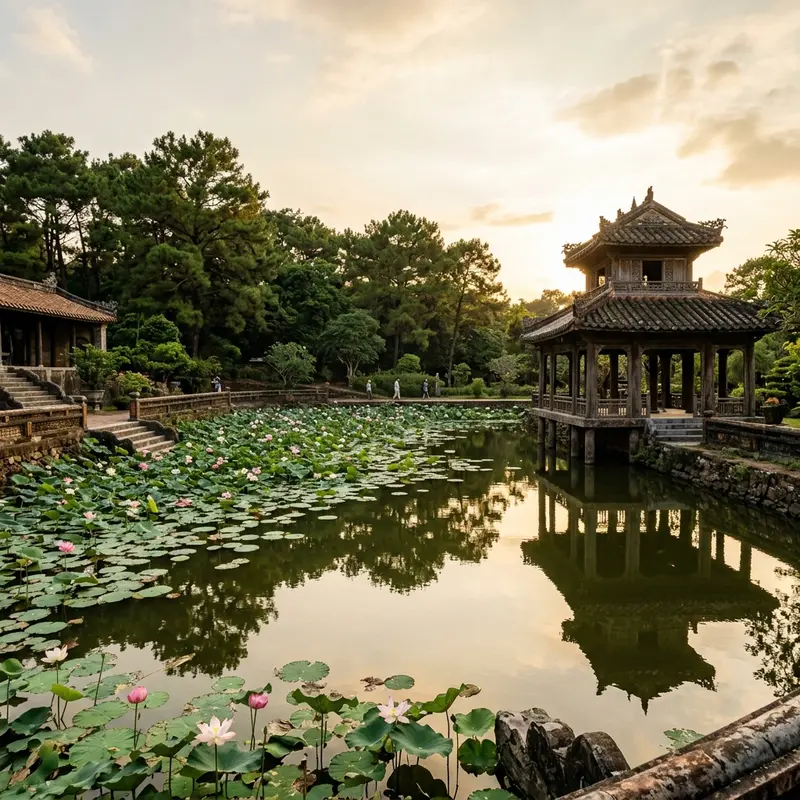
Tu Duc Tomb — Where a Poet King Poured His Soul
The Saddest Story Among the Nguyen Kings
Tu Duc (1829–1883) reigned for 36 years – the longest of all Nguyen kings – but his life was full of tragedy. He suffered from smallpox from a young age, which left him unable to have children, despite having over 100 concubines. Meanwhile, the country gradually fell into the hands of the French colonialists, and he was forced to sign humiliating treaties. To escape the painful reality, Tu Duc retreated into poetry and literature – he left behind over 4,000 poems, making him the most prolific poet king in Southeast Asia.
And it was this poetic soul that created Khiem Tomb (the official name of Tu Duc Tomb) – a space unlike any other royal tomb. If Minh Mang Tomb is a symphony, then Tu Duc Tomb is a lyrical poem.
Architecture: As Romantic as a Landscape Painting
Tu Duc Tomb was built from 1864 to 1867, but it was actually completed while the king was still alive, and he used this place as a resort palace for 16 years before his death. This is the most unique aspect of this tomb: it served as both the king’s residence and his burial place.
The entire tomb complex covers about 12 hectares, surrounded by ramparts and pine forests. The central point is Luu Khiem Lake – a large body of water with Tinh Khiem Island, where the king often rowed, fished, and wrote poetry. On the island is Xung Khiem Ta – a small, charming pavilion house situated right on the water, which is the most beautiful and iconic check-in spot of the entire complex.
Unlike Minh Mang Tomb, which has a strict symmetrical axis, Tu Duc Tomb has a more free-flowing layout, harmonizing with the natural terrain. There are winding paths through the pine forest, and unexpected hidden corners leading to a stone bench or a secluded lakeshore. This is a place to go slowly, to feel, not to “check off all the spots.”
[!TIP] Tu Duc Tomb is an ideal place for “film” and “vintage” style photography. The light filtering through the pine forest creates beautiful, ethereal sunbeams. The timeThe hours are from 8:30 AM to 10:00 AM and from 3:00 PM to 5:00 PM.
Bi Dinh And The King’s Confession Stele
One of the most interesting spots here is Bi Dinh with its giant 2.6-meter-tall stone stele. The special thing about it is that the inscription was composed by King Tu Duc himself, and in it, he frankly admits his mistakes in ruling the country and acknowledges his responsibility for allowing the nation to fall into foreign hands. This is one of the rare historical documents where a king self-critiques so honestly.
Reading those lines, I suddenly felt that Tu Duc was no longer a distant historical figure, but a real person—pained, lonely, and incredibly humane.
[!NOTE] The exact burial site of King Tu Duc remains a mystery to this day. According to legend, after the king was buried, all 200 workers involved in digging the grave were executed to maintain secrecy. The current Buu Thanh is only a place of worship, not the actual burial site.
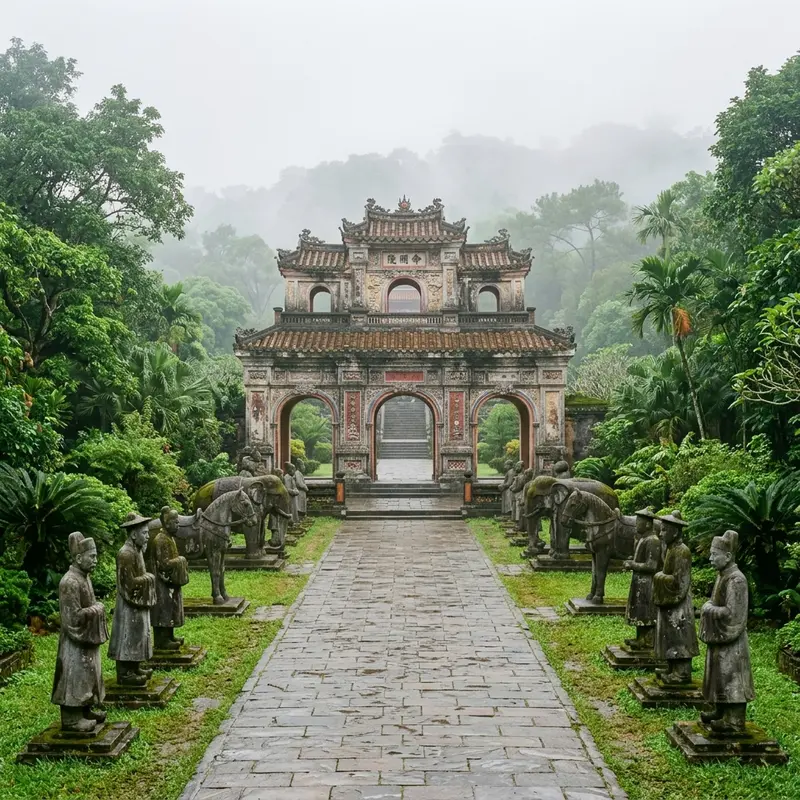
Khai Dinh Tomb — Where East Meets West on Chau Chu Peak
The Most Controversial King And A Unique Monument
Khai Dinh (1885–1925) was the 12th king of the Nguyen Dynasty, and he is arguably the most controversial king in history. Some criticize him as a “puppet” of the French colonialists, even increasing taxes by 30% to build his tomb. However, from an artistic and architectural perspective, it’s undeniable that Ung Lang Tomb (its official name) is one of the most unique structures in Vietnam.
The tomb was built from 1920 to 1931—taking 11 years—with a bold fusion of Eastern and Western architecture: Romanesque domes, Greek columns, Buddhist motifs, Chinese influences, and traditional Vietnamese mosaic art. It might sound chaotic, but when you stand before the actual structure, you’ll see how miraculously everything blends together.
Climb 127 Steps And The Reward Awaits Above
Khai Dinh Tomb is situated on the slope of Chau Chu mountain, and to enter the tomb, you must climb 127 stone steps. This deters many people, but trust me—the reward is absolutely worth it.
From the steps leading up, you’ll pass through five courtyards with rows of meticulously carved stone statues of civil and military officials, elephants, and horses. This is one of the most beautiful sets of stone statues remaining from the Nguyen era.
The pinnacle of the tomb is Thien Dinh Cung—the main temple located on the highest level. Inside the temple is a masterpiece of mosaic and stained glass art covering the ceiling and walls, creating a dazzlingly overwhelming space. Millions of porcelain shards from France, Japan, and China were broken and pieced together to form colossal murals depicting nature, the Four Sacred Beasts, and the Eight Treasures. This is the masterpiece of artisan Phan Van Tanh, who spent nine years completing the entire interior.
In the center of the temple is a life-sized bronze statue of King Khai Dinh seated on his throne, cast in France in 1922. Beneath the bronze statue is the burial site of the king’s remains—one of the very few Nguyen tombs where the burial location is precisely identified.
[!WARNING] Khai Dinh Tomb has many steep and slippery steps, especially during the rainy season. Absolutely do not wear flip-flops or high heels. It is recommended to wear comfortable clothing and be prepared for a walk. Elderly individuals or those with knee problems should reconsider.
The Best Photo Spot At Khai Dinh Tomb
The best angle to capture a panoramic view of the tomb is not from inside, but from the road leading to the tomb, at a distance of 50–100 meters.from the main gate. From here, you can see the entire complex nestled on a green mountainside, with its unique architecture standing out amidst the pine forest — a picture-perfect scene that needs no filter.
Inside, the second and third courtyards with rows of stone statues are the most “soulful” spots for photos. Natural light shining down from above creates beautiful contrasts.

Guide to Traveling from Da Nang / Hoi An to Hue Tombs
Actual Distance and Travel Time
From Da Nang to Hue: approximately 100 km, taking 2 to 2.5 hours by car via Hai Van Pass — one of the most beautiful routes in Vietnam. From Hoi An to Hue: approximately 120 km, taking 2.5 to 3 hours.
Upon arriving in Hue, from the city center to each tomb:
- Khai Dinh Tomb: 10 km, about 20 minutes by motorbike or car.
- Tu Duc Tomb: 7 km, about 15 minutes.
- Minh Mang Tomb: 12 km, about 25 minutes.
Why Choose a Transfer Service Instead of Self-Driving?
This is the question I get asked most often. The practical answer: if you’re traveling alone or in a small group and want to explore independently, a rented motorbike is a popular choice. But if you’re traveling with family, elderly people, or want a complete journey without worrying about roads, time, and safety — then a package transfer service is a much smarter option.
Specific reasons:
Hai Van Pass is notoriously one of the most dangerous stretches of road in Vietnam, especially during the rainy season (September to December). Dense fog, slippery roads, and numerous hairpin turns make self-driving risky.
The roads to the tombs from Hue city center are not always clear on Google Maps. Many small roads, incomplete signage, and if you’re unfamiliar with the terrain, you can easily get lost or waste an extra 30–45 minutes unnecessarily.
That’s why I always recommend friends and readers use the services of Faifo Express — a reputable transport company with local drivers who are knowledgeable about every road and every attraction. Beyond just taking you from A to B, Faifo Express drivers can also advise on a reasonable sightseeing order, the best times of day to visit each tomb, and good local eateries nearby that not all tour guides know.
Faifo Express offers:
- Da Nang Airport transfer service directly to Hue or stopping in Hoi An along the way.
- Hoi An car service combined with a visit to the Ancient Town before heading to Hue.
- Ba Na Hills car service for days when you want to explore the mountainous areas around Da Nang.
- Daily car rental service to Hue with local drivers, fixed prices, no extra charges.
[!TIP] Book your Faifo Express car at least 1 day in advance to prioritize vehicle and driver availability that suits your itinerary. If you want to combine all three tombs in one day, inform them in advance so the driver can arrange an optimal route: Khai Dinh Tomb → Tu Duc Tomb → Minh Mang Tomb (in order from closest to farthest from the center).
Estimated Costs for a Day of Visiting Hue Tombs
Entrance Ticket Prices (Updated 2024–2025)
[!NOTE] Pricing Note for International Tourists The prices listed are inclusive of a 20% tax and service fee applied to foreign tourists. Estimated USD rates are based on current exchange rates and may slightly vary.
| Location | Adult Ticket Price | Children (under 1.2m) |
|---|---|---|
| Minh Mang Tomb | 180,000 VND (≈$7) | Free |
| Tu Duc Tomb | 180,000 VND (≈$7) | Free |
| Khai Dinh Tomb | 180,000 VND (≈$7) | Free |
| Combo Ticket for 3 Tombs + Imperial City | 432,000 VND (≈$17) | Free |
[!TIP] If you plan to visit the Imperial City of Hue and otherIf you plan to visit other historical sites, purchase a combo ticket at any location — it’s significantly cheaper than buying individual tickets for each site. The combo ticket is valid for 2 consecutive days.
Food Costs Near the Tombs
The area around the tombs doesn’t offer many high-end dining options, but there are plenty of delicious, affordable local eateries. Some suggestions:
- Bun Bo Hue at small eateries on Le Ngo Cat Street (near Tu Duc Tomb): 35,000–60,000 VND (≈$2)/bowl.
- Com Hen, Banh Canh Cua at An Cuu Market: 25,000–48,000 VND (≈$2).
- Hue Grilled Pork Banh Mi (completely different from Da Nang or Hoi An banh mi): 24,000 VND (≈$1).
Frequently Asked Questions
Frequently asked questions about Hue's 3 Most Beautiful Royal Tombs to Discover
What is the best way to use this guide to Hue's 3 Most Beautiful Royal Tombs to Discover?
Is Hue's 3 Most Beautiful Royal Tombs to Discover suitable for a first-time visitor?
Can I combine Hue's 3 Most Beautiful Royal Tombs to Discover with other nearby plans?
What should I confirm before making plans for Hue's 3 Most Beautiful Royal Tombs to Discover?
How can I avoid last-minute problems with Hue's 3 Most Beautiful Royal Tombs to Discover?
Tags
The Faifo Express
This article was written by the driver and travel consultant team at Faifo Express — over 5 years of experience in travel transport across Da Nang, Hoi An, and Hue. All information is based on real experience serving 5,000+ customers every month.
Related services
Airport Transfer
Hotel pickup, all-inclusive price
View DetailsDay Tour Car Rental
Ba Na Hills, Hoi An, My Son...
View DetailsShared Car
From just 100K VND/person
View DetailsTourist Car Rental
Explore the beauty of Central Vietnam with our private tourist car service.
View Details🛣️ Popular Routes


Follow Faifo Express
Get exclusive deals, real reviews and the latest Central Vietnam travel tips.
Faifo Express
Updates, customer reviews & real trip photos.
@trm.anh.travel
Real experience videos, Da Nang – Hoi An travel tips.
@xedichvudananghoianhue
Real videos of routes, fleet and transfer services.
@xedananghoianFE
Quick news, flash deals and direct interaction.
DM us on Facebook — response within 5 minutes