


The Fujian Assembly Hall: Where Hoi An's Chinese Merchants Prayed for Safe Passage
📋 Table of Contents
There are places where, just by stepping through the gate, you can feel the weight of centuries of history pressing down on your shoulders. The Fujian Assembly Hall in Hoi An is one of the few such places — where every tile, every wooden pillar, every wisp of incense smoke tells a story of the long journey of Fujian Chinese people who left their homeland, crossed the South China Sea, and settled in this prosperous trading port from the 17th century. As someone born and raised in Quang Nam province, I have set foot in the Fujian Assembly Hall countless times — yet each visit, I still find myself drawn into another dimension, where time seems to stand still and spirituality becomes tangible. This is not just a beautiful check-in spot for your travel photos — this is Hoi An’s most unique spiritual architectural work that you will regret for a lifetime if you miss it.
What is the Fujian Assembly Hall? Its Little-Known Origins and History
From a Small Shrine to a Grand Spiritual Monument
Few people know that the Fujian Assembly Hall was not built in its entirety from the beginning. Its origin was a small shrine erected in 1697, dedicated to a statue of Thien Hau Thanh Mau — the goddess who protects fishermen and seafarers — which was salvaged from a shipwreck offshore. This story might sound like a legend, but for the Fujian Chinese, it was a sacred sign, a call for them to contribute their labor and resources to build a worthy place of worship.
By 1759, the Fujian Chinese community in Hoi An — by then a wealthy and organized merchant community — officially expanded and upgraded the structure into a proper assembly hall. Since then, through several renovations in 1900, 1975, and most recently in the early 21st century, the Fujian Assembly Hall has retained its characteristic Southern Chinese architectural soul without being adulterated or losing its identity.
An interesting detail that many tour guides often overlook: the assembly hall was not just a place of worship. Historically, it also served as a center for trade coordination, internal dispute resolution, and support for newly arrived Fujian people in Hoi An. In other words, it was the unofficial “city hall” for the Fujian Chinese community for centuries.
Its Position in Hoi An’s Five Assembly Halls System
Hoi An has a total of five assembly halls built by various Chinese groups: Fujian, Guangdong, Trieu Chau, Hai Nam, and Chinese (for all provinces). Among them, the Fujian Assembly Hall is considered the largest in scale, the most magnificent in architecture, and the best preserved. If you only have time to visit one assembly hall in Hoi An, this should definitely be your top choice.
Fujian Assembly Hall Architecture: An Encyclopedia in Stone and Wood
The Three-Arched Gate — A Solemn First Greeting
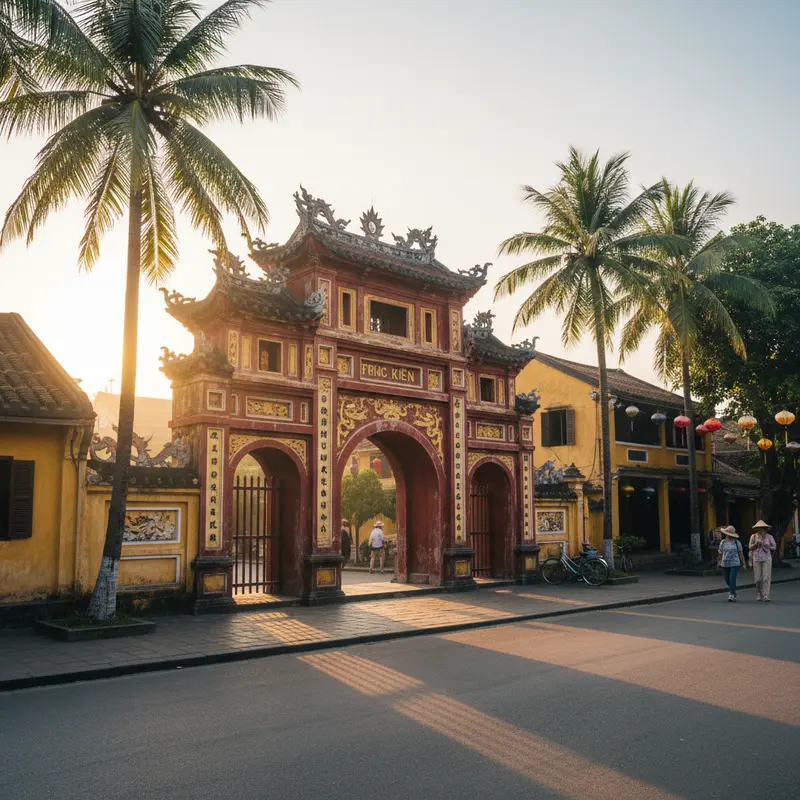
Stepping off the bustling Tran Phu street, you will be met by the three-arched gate of the Fujian Assembly Hall — a standalone structure in front of the courtyard, built entirely of green stone and vua o duoc (a traditional mortar made from lime, molasses, and paper). The gate has three entrances; the central one is for deities and important ceremonies, while the two side entrances are for ordinary people. At the top of the gate are Chinese characters “Phuc Kien Hoi Quan” and exquisitely carved bas-reliefs of dragons, phoenixes, and qilin.
A detail I often point out to friends when I bring them here:Look closely at the dragons on the roof gables — these are Southern Chinese style dragons, with slender bodies and small heads, distinctly different from the dragons in Hue’s imperial architecture or the Ly-Tran dynasty dragons of the Vietnamese people. This is the clearest evidence of cultural exchange without needing to read a single line of history.
Spatial Layout: The Philosophy of Present Feng Shui
The entire Fujian Assembly Hall complex is laid out along the North-South axis, strictly adhering to Southern Chinese feng shui principles: from outside to inside, there is the three-door gate, the front courtyard, the main hall, the central courtyard (with a skylight), the main sanctuary, and finally, the rear sanctuary. This arrangement is not accidental — it creates a spiritual journey guiding visitors from the secular world into the sacred space.
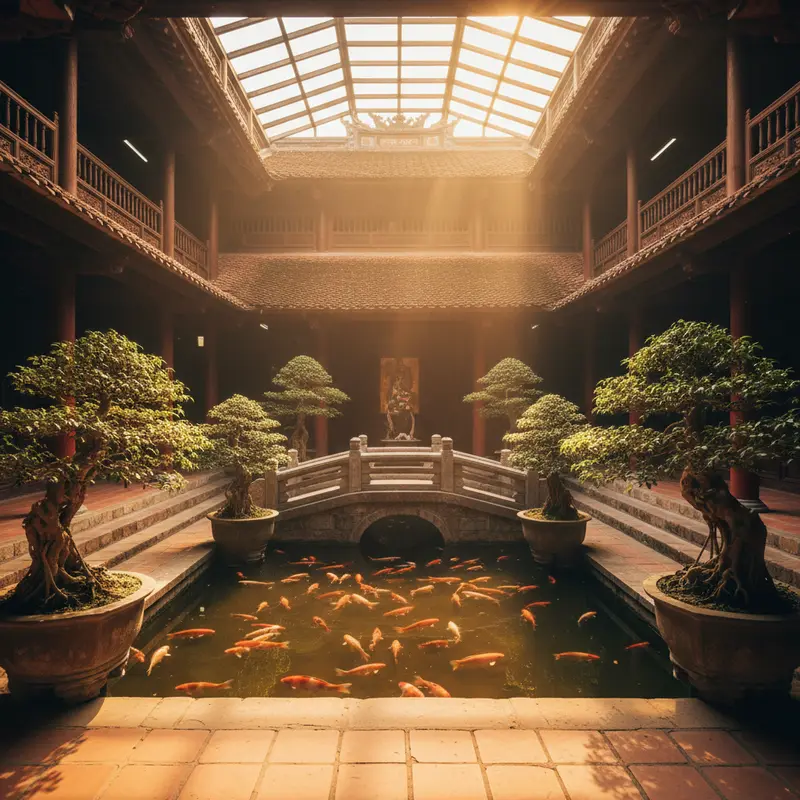
The central courtyard is my favorite part of the entire complex. It’s an open space with two large koi ponds, ancient bonsai trees, and a small stone bridge crossing the water. Natural light pouring down from the skylight creates a wonderful lighting effect in the early morning — this is a photographic spot sought after by many professional photographers but little known to ordinary tourists.
The Main Sanctuary — The Heart of the Assembly Hall
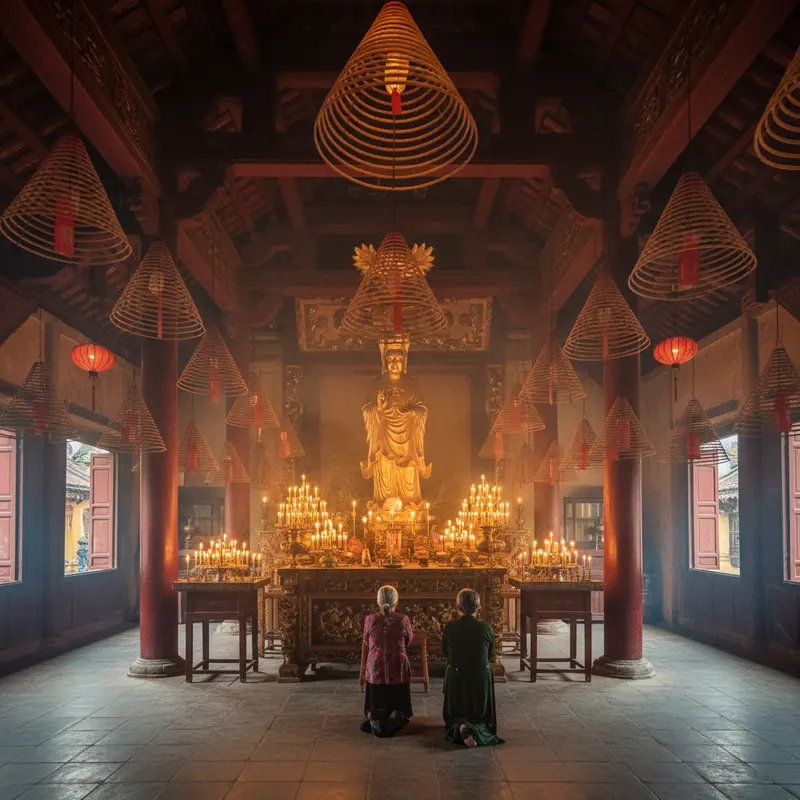
The main sanctuary is where Thien Hau Thanh Mau (Sea Goddess) is worshipped — the most important deity for the Fujian people. The statue of Thien Hau is placed in the center, flanked by Kim Hoa Nuong Nuong (goddess protecting women and children) and Tai Bach Tinh Quan (god of wealth). The main sanctuary is always dimly lit by incense smoke and flickering candlelight, creating a spiritual atmosphere that is difficult to describe in words.
Pay special attention to the incense coils hanging from the ceiling — these are giant cone-shaped incense coils, with diameters of up to 50-70cm, suspended and burning continuously for many days. It is believed that the smoke from these incense coils carries prayers to the heavens. Looking up from below, dozens of burning incense coils create a scene that is both mystical and as impressive as any installation art.
The Rear Sanctuary And Things You Shouldn’t Miss
Most tourists stop at the main sanctuary and then turn back, missing the rear sanctuary — where Luc Tanh Vuong Gia (the six guardian deities of the six Fujian clans) and other subsidiary altars are housed. This is the most community-oriented area of the assembly hall, where you can understand how the Fujian Chinese organized their society by clan and belief.
Additionally, along the two corridors connecting the front hall to the rear sanctuary are vibrantly colored ceramic bas-reliefs depicting ancient Chinese legends. This is the longest and most beautiful “comic book” made of ceramics among all the assembly halls in Hoi An, created by artisans from Fujian who came directly in the early 20th century.
[!NOTE] All original building materials of the Fujian Assembly Hall — from bricks, tiles, and wood to decorative elements — were shipped directly from Fujian Province, China, by sailboat. This is why the assembly hall’s architecture is much more “original” compared to structures built on-site with local materials.
Guide to Getting to the Fujian Assembly Hall
Address and Location
The Fujian Assembly Hall is located at 46 Tran Phu Street, Minh An Ward, Hoi An, Quang Nam — right on the main ancient street of Hoi An Ancient Town. This location is extremely convenient: it is only about 400m east of the Japanese Covered Bridge, situated withinthe pedestrianized area of the ancient town, so you can easily visit multiple spots in one go.
From Da Nang to Hoi An: Don’t Let Your Trip Start With a Mistake
Most tourists to Hoi An depart from Da Nang — the distance is only about 30km, but this is where many people fall into the “trap.” Traditional taxis in Da Nang often run on meters and can take circuitous routes, while Grab depends on the driver — some are good, others don’t know the way. I’ve witnessed quite a few friends from Hanoi and Ho Chi Minh City arrive in Da Nang and then get “ripped off” or lost when they arbitrarily booked a car.
My sincere advice: use Faifo Express’s Da Nang - Hoi An shuttle service — a local transportation company specializing in the Da Nang - Hoi An route and tourist spots in the region. The biggest difference between Faifo Express and regular taxis is that the drivers are all locals, familiar with every road, every location, and especially — fixed prices, no meters, no hidden fees. You know exactly how much you’ll pay before getting in the car, and that amount doesn’t change whether there’s traffic or rain.
If you’ve just landed in Da Nang and want to head straight to Hoi An, Faifo Express’s Da Nang airport transfer to Hoi An service is the optimal choice — they pick you up directly, no waiting, no haggling, no worries about bulky luggage.
[!TIP] If you’re planning a long day of sightseeing (Fujian Assembly Hall + Hoi An Ancient Town + Thanh Ha Pottery Village + Cham Island), rent a car for the day from Faifo Express instead of booking individual trips. The driver will wait for you and take you to each spot according to your itinerary — much more economical and flexible.
From Hoi An Center to the Assembly Hall
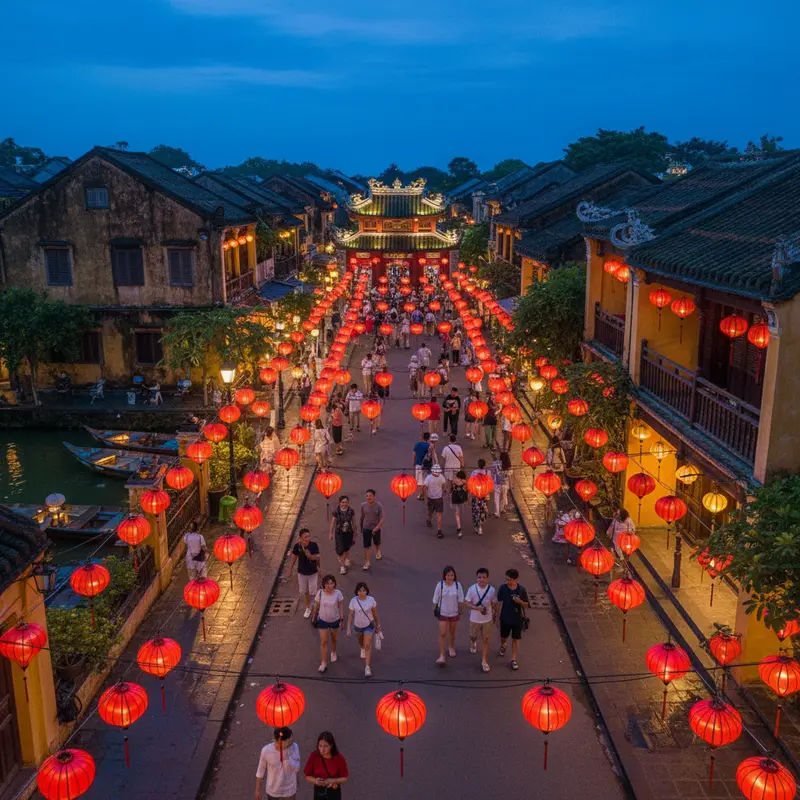
Once you’re in the Hoi An Ancient Town area, you can only travel by walking or cycling — the ancient town prohibits motorbikes and cars during many hours. This is actually something I really like about Hoi An: it forces you to slow down, walk through the stone-paved streets, peek into every alley, smell the bougainvillea and incense before reaching the Fujian Assembly Hall.
From Hoi An bus station (the largest parking area near the ancient town), it’s about a 10-12 minute walk to get there. The path is completely straight, you can’t get lost.
Real Experience at the Fujian Assembly Hall
Must-Do Things
Light incense and pray: This isn’t just for show — if you respect the local beliefs, buy a small bundle of incense (sold at the entrance, costing around 10,000-24,000 VND (≈$1)) and light it according to the ritual. People come here to pray for health, love, and prosperity — and according to many locals, the Goddess Thien Hau here is “very divine.”
Explore every architectural corner: Don’t just stand in the main hall and leave. Follow the clockwise path around the entire complex, paying attention to every small detail: the patterns on the columns, the animal statues on the roof, the Chinese characters on the horizontal lacquered boards, and especially the ceramic paintings on the corridor walls.
Sit in the central courtyard: This is a piece of advice I always give to anyone visiting the Fujian Assembly Hall. Find a seat in the central courtyard, close your eyes, and listen — the sound of the wooden clapper from the main hall, the splashing of fish in the pond, the wind blowing through the tiled roof. This is a meditation experience that doesn’t require an appointment.
Take photos at “secret” spots: The best angle to capture the panoramic view of the nineThe viewpoint is from the small stone bridge in the central courtyard, looking straight ahead. The second best angle is from the right corridor looking left, where natural light creates an impressive chiaroscuro effect in the morning.
Festivals and Special Events
If you’re lucky, you might visit during the Thien Hau Holy Mother’s Birthday (23rd day of the 3rd lunar month) — this is the biggest festival of the year for the Fujian Assembly Hall, featuring palanquin processions, incense offerings, lion dances, and traditional Chinese music performances. The atmosphere on this day is completely different from a regular day — crowded, bustling, vibrantly colorful, and you’ll witness a rare, living, and intact spiritual festival.
Additionally, on full moon nights each month (14th and 15th lunar days), the Fujian Assembly Hall is illuminated by lanterns and candles, creating a magical scene no less impressive than in historical dramas. This is the time I recommend visiting if you want to capture truly stunning photos.
What to Eat After Your Visit?
Tran Phu Street and its surrounding streets are a culinary paradise in Hoi An. After visiting the Fujian Assembly Hall, here are my recommendations:
- Cao Lau Hoi An: The most characteristic noodle dish of Hoi An, it’s only truly delicious when eaten here because the water from Ba Le well is an irreplaceable ingredient. Cao Lau Khach restaurant (26 Thai Phien Street) is my most trusted address.
- Banh Mi Phuong: About a 5-minute walk from the Fujian Assembly Hall, at 2B Phan Chau Trinh Street. It needs no further introduction.
- Chinese-style Three-Color Sweet Soup: Few people know that along Tran Phu Street, there are several traditional Chinese dessert stalls selling Fujian-style sweet soups — delicately sweet, refreshingly cool, and priced only at 15,000-30,000 VND (≈$1) per cup.
Cost of Visiting the Fujian Assembly Hall: A Practical Breakdown
Entrance Tickets
The Fujian Assembly Hall is part of the Hoi An Ancient Town ticket system — you don’t buy separate tickets for each site but a combined ticket. Specifically:
[!NOTE] Pricing Note for International Tourists The prices listed are inclusive of a 20% tax and service fee applied to foreign tourists. Estimated USD rates are based on current exchange rates and may slightly vary.
| Ticket Type | Price (Adult) | Notes |
|---|---|---|
| Ancient Town Ticket (5 sites) | 144,000 VND (≈$6) | Choose 5 from the listed sites |
| Children under 7 years old | Free | No ticket required |
| Elderly (over 60) | 72,000 VND (≈$3) | ID card/Citizen ID required |
With the 144,000 VND (≈$6) ticket, you can visit 5 attractions in the ancient town — the Fujian Assembly Hall should definitely be one of them. For the remaining sites, I suggest: the Japanese Covered Bridge, Tan Ky Old House, Sa Huynh Culture Museum, and the Cantonese Assembly Hall.
Transportation Costs
| Means of Transport | Price | Notes |
|---|---|---|
| Taxi from Da Nang to Hoi An | 350,000 - 600,000 VND (≈$23) | Depends on the company, prone to overpricing |
| Grab from Da Nang to Hoi An | 280,000 - 456,000 VND (≈$18) | Prices fluctuate during peak hours |
| Faifo Express Shuttle Bus | Fixed price, contact directly | All-inclusive, no extra fees |
| Da Nang - Hoi An Bus | 36,000 VND (≈$1)/person | Cheap but not flexible |
Estimated Total Cost for a Day of Sightseeing
A day exploring Hoi An with the Fujian Assembly Hall as the highlight, the average cost for one person:
- Ancient Town Ticket: 144,000 VND (≈$6)
- Breakfast + Lunch + Snacks: 150,000 - 300,000 VND (≈$12)
- Incense for offerings at the hall: 10,000 - 24,000 VND (≈$1)
- Bicycle rental in the ancient town: 50,000 - 96,000 VND (≈$4)/day
- Souvenir shopping (optional): 100,000 - 600,000 VND (≈$23)
- Total: approximately 430,000 - 1,160,000 VND (≈$45) (excluding transportation from Da Nang)
[!WARNING] Some unofficial ticket sellers may approach you at the entrance of the assembly hall and offer to sell you ticketswith “promotional” prices or “special combo tickets.” Do not buy. Hoi An Ancient Town entrance tickets are only sold at official ticket booths with signage from the Hoi An Ancient Town Management Board. Buying fake tickets will not only waste your money but also result in being denied entry.
Practical Experience: Tips from Locals
Ideal Times to Visit
Early morning (7 AM - 9 AM) is the golden hour to visit the Fujian Assembly Hall. Reasons:
- The most beautiful natural light, especially the effect of early sunlight shining through the skylight
- The number of tourists is still low, allowing you to explore and take photos at your leisure
- The most serene spiritual atmosphere — many locals come to offer incense in the early morning, creating a very special ambiance
Avoid the hours of 10 AM - 3 PM — this is the peak time when large tour groups arrive and the midday sun is intense, making it crowded and difficult to fully appreciate the peaceful spiritual ambiance or take clean photos.
💡 Faifo Express Tip: Check our popular transfer routes and detailed pricing list to plan your smooth journey across Central Vietnam.
Frequently Asked Questions
Frequently asked questions about Fujian Assembly Hall
What is the best way to use this guide to Fujian Assembly Hall: Hoi An's Stunning Architecture?
Is Fujian Assembly Hall: Hoi An's Stunning Architecture suitable for a first-time visitor?
Can I combine Fujian Assembly Hall: Hoi An's Stunning Architecture with other nearby plans?
What should I confirm before making plans for Fujian Assembly Hall: Hoi An's Stunning Architecture?
How can I avoid last-minute problems with Fujian Assembly Hall: Hoi An's Stunning Architecture?
Tags
The Faifo Express
This article was written by the driver and travel consultant team at Faifo Express — over 5 years of experience in travel transport across Da Nang, Hoi An, and Hue. All information is based on real experience serving 5,000+ customers every month.
Related services
Airport Transfer
Hotel pickup, all-inclusive price
View DetailsDay Tour Car Rental
Ba Na Hills, Hoi An, My Son...
View DetailsShared Car
From just 100K VND/person
View DetailsTourist Car Rental
Explore the beauty of Central Vietnam with our private tourist car service.
View Details🛣️ Popular Routes

Follow Faifo Express
Get exclusive deals, real reviews and the latest Central Vietnam travel tips.
Faifo Express
Updates, customer reviews & real trip photos.
@trm.anh.travel
Real experience videos, Da Nang – Hoi An travel tips.
@xedichvudananghoianhue
Real videos of routes, fleet and transfer services.
@xedananghoianFE
Quick news, flash deals and direct interaction.
DM us on Facebook — response within 5 minutes