


The Japanese Bridge: 400 Years of History in One Small Crossing
📋 Table of Contents
[!NOTE] Pricing Note for International Tourists The prices listed are inclusive of a 20% tax and service fee applied to foreign tourists. Estimated USD rates are based on current exchange rates and may slightly vary.
Hoi An’s Japanese Bridge – When a Small Wooden Bridge Carries 400 Years of History
There are places you visit once and never forget. Not because they are grand or opulent, but because they hold something hard to define – a soul, a collective memory, an invisible thread connecting the past to the present. Hoi An’s Japanese Bridge is exactly like that.
I was born and raised in Da Nang, and I’ve cycled to Hoi An countless times just to sit and gaze at that old bridge at dawn, when the mist still clung to the Hoai River. Each time, I felt I understood a little more about this ancient town – a place where Japanese, Chinese, and Vietnamese people once traded, clashed, and reconciled on a bridge less than twenty meters long.
This article is not a dry tourist introduction. This is what I know about the Japanese Bridge – from its true history, architectural details that tour guides often overlook, to how to experience a morning here without being jostled by hundreds of other tourists.
What is the Japanese Bridge? 400 Years of History Not Everyone Knows Fully
Origins and Historical Context
If you ask any Hoi An local about the Japanese Bridge, they’ll immediately say: “The Japanese Bridge.” And indeed – this bridge was built by the Japanese merchant community around the late 16th to early 17th century, roughly between 1593 and 1625. At that time, Hoi An (or Faifo, as Westerners called it) was one of the busiest trading ports in Southeast Asia.
The Japanese built this bridge for practical reasons: to connect their quarter north of the river with the Chinese business district to the south. But behind this practicality lay a deep religious belief. According to local legend, the Japanese believed that at the bottom of the ocean lay a giant monster named Mamazu (or Cu) – its head in India, its tail in Japan, and its body stretched across Hoi An. Whenever this monster stirred, earthquakes shook Japan. The bridge was built as a sword plunged into the monster’s back to subdue it and prevent earthquakes.
That’s why at both ends of the bridge, there are two pairs of guardian animal statues: one end has dogs (Tuat), and the other has monkeys (Than). Some researchers believe these symbolize the years of the dog and the monkey – the bridge’s commencement and completion dates. Others interpret them as protective spirits, warding off evil from both sides.
[!NOTE] Many travel documents state the bridge was built in 1593, but historians are still undecided on the exact year. What is certain is that the bridge has existed since the early 17th century and has undergone at least 7 major renovations in the years 1653, 1719, 1763, 1817, 1875, 1915, and 1986.
Why is it Called “Japanese Covered Bridge” (Pagoda Bridge)?
This is a question many tourists wonder: the structure is clearly a bridge, so why is it called a “pagoda”? The answer lies in the small temple built right on the bridge, on its northern side. This temple enshrines Huyen Thien Dai De (also known as Tran Vo Dai De) – a deity in Taoist belief, believed to have the power to control weather and protect seafarers.
Interestingly, this temple was not built by the Japanese – the Japanese left Hoi An in the early 17th century after Japan issued a ban on its citizens going abroad. It was the subsequent Chinese and Vietnamese communities who repaired and added the temple, transforming the bridge into a mixed religious space – both a connecting bridge and a place of worship.The name “Japanese Covered Bridge” (Lai Vien Kieu) was officially given by Lord Nguyen Phuc Chu when he visited Hoi An in 1719. “Lai Vien” means “distant guests arriving” – a name that is both diplomatic and reflects Hoi An’s international trading port nature.
Architecture: A Rare Cultural Intersection
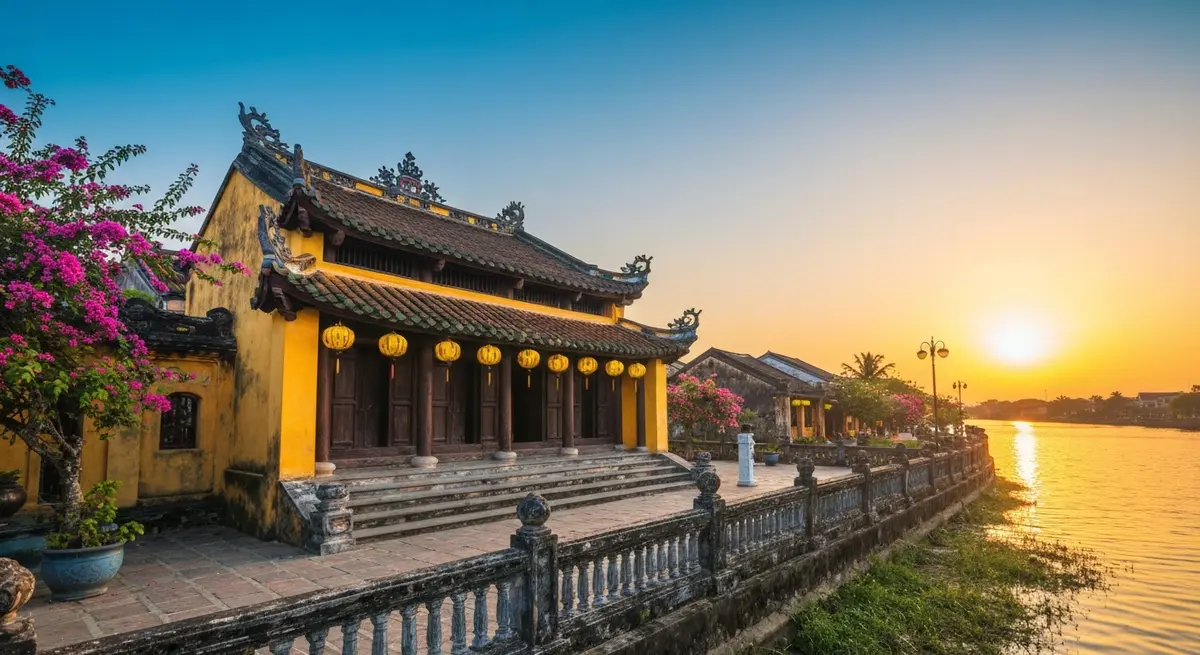
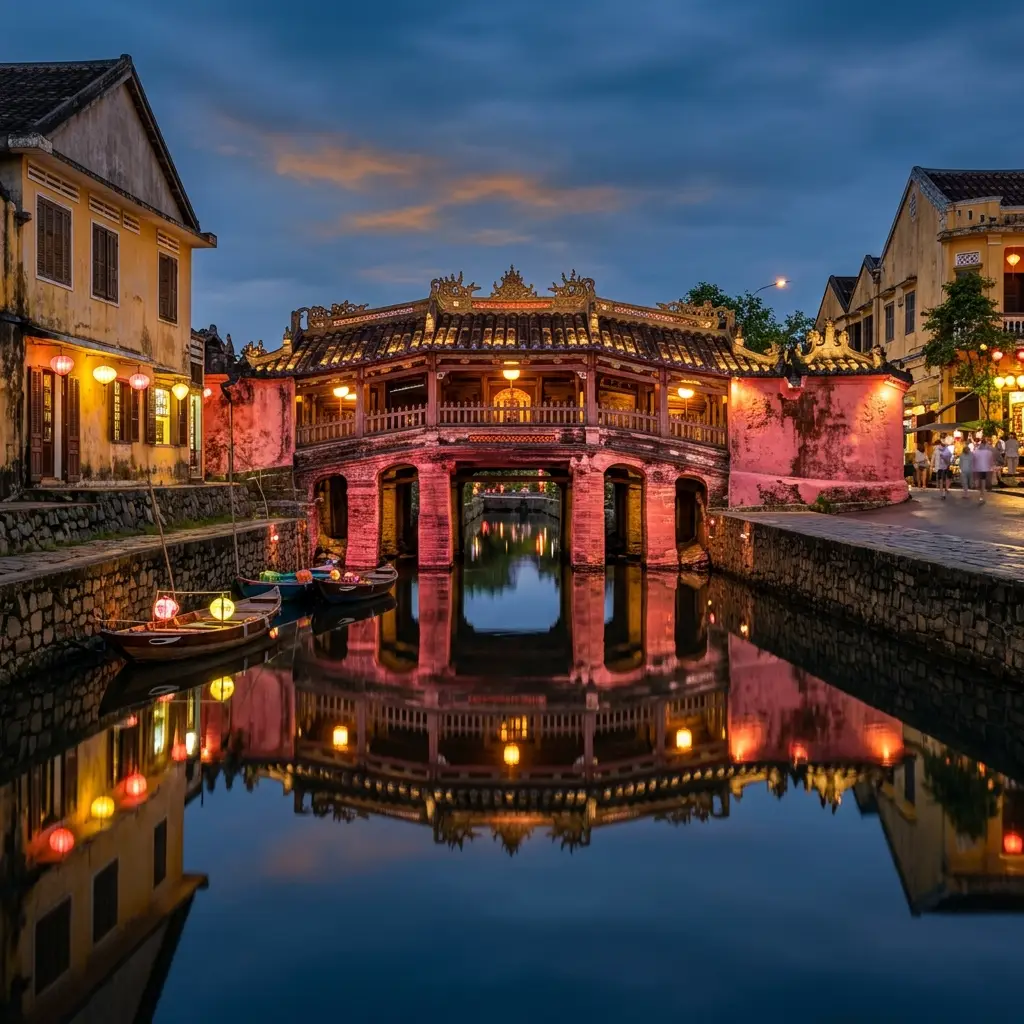
Looking at the bridge, you’ll immediately notice the unique blend of three cultures. The curved roof with its elegant, flowing lines strongly embodies the architectural style of Japan’s Edo period. The interior decoration, with its dragon and phoenix motifs and vibrant red-gold colors, clearly shows Chinese cultural influence. Meanwhile, the wooden structure and the arrangement of the worship space lean towards the architectural style of Vietnamese communal houses.
The bridge is approximately 18 meters long and 3 meters wide, spanning a small branch of the Hoai River. The entire structure is made of wood – not a single iron nail is used in the main load-bearing structure. This is a traditional mortise and tenon technique used by Japanese and Vietnamese carpenters, allowing the bridge to “breathe” with changes in temperature and humidity without cracking.
A detail few people notice: the roof is covered with yin-yang tiles – a characteristic type of tile in Hoi An architecture, arranged in an overlapping convex-concave pattern to ensure good drainage during the tropical rainy season. Looking up from below, you’ll see intricately carved wooden beams with vine and bird motifs.
Experiencing the Japanese Covered Bridge: More Than Just a Photo Op
When is the Best Time to Visit? A Local’s Secret
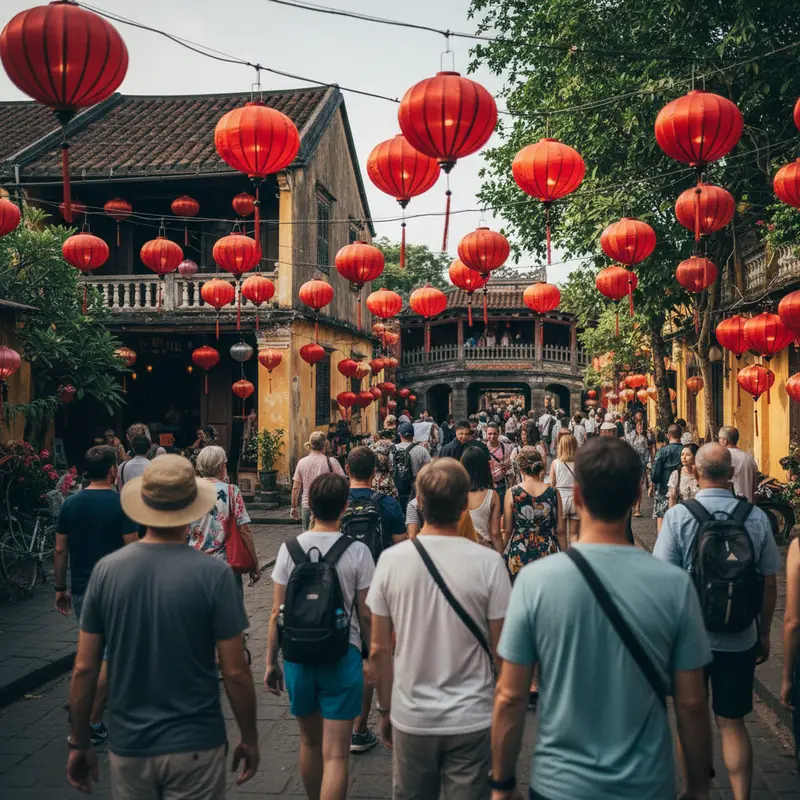
This is the most important question that most travel articles fail to answer satisfactorily. The Japanese Covered Bridge is located right in the heart of the Ancient Town, and from around 8 AM to 5 PM, the area is always crowded with tourists. During peak season (March to August), you’ll have to queue to get a photo without strangers in it.
My secret – and that of many Hoi An locals – is to visit at 6 AM. At this time, the gentle golden light of dawn streams through the moss-covered tiles, the air is still cool, and most importantly: there’s almost no one around. You can stand in the middle of the bridge, look down at the calm water below, and feel the quiet atmosphere that this bridge has held for four centuries.
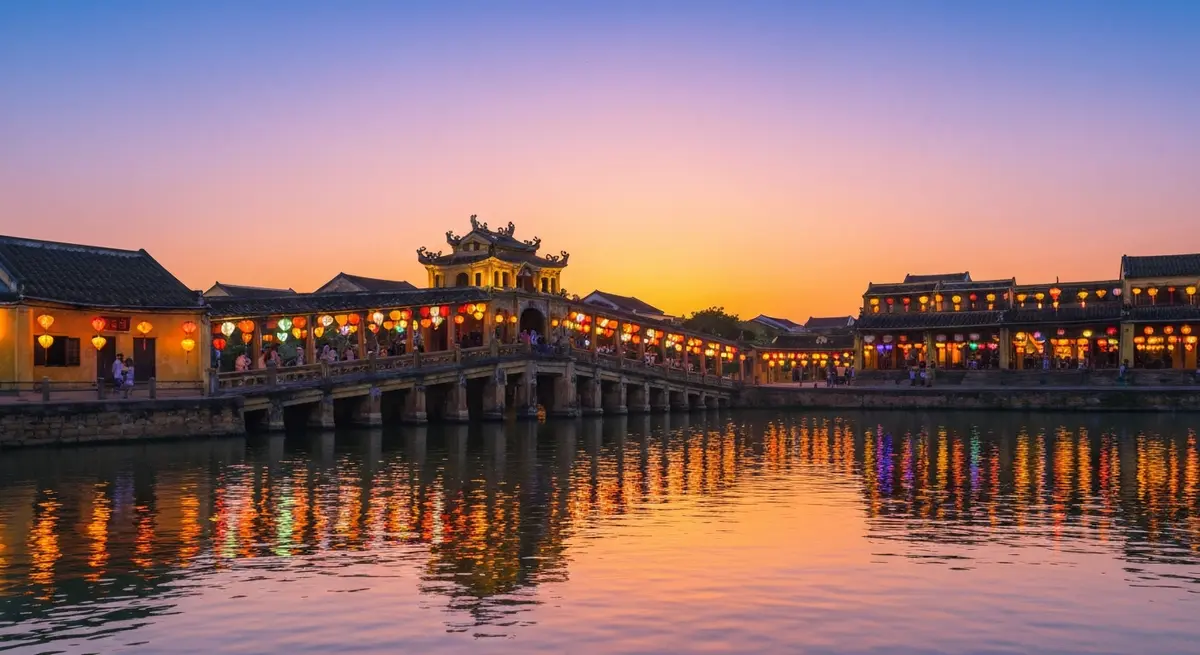
Another option is 7 PM – when the lanterns are lit, and the entire Ancient Town glows with golden light. The bridge at this hour has a completely different beauty: mysterious, romantic, and incredibly photogenic.
[!TIP] If you visit during the full moon (the 14th day of the lunar month), Hoi An organizes the Ancient Town Night – all electric lights are turned off, and only lanterns are lit. The bridge on this night is so beautiful you won’t want to leave. This is the best time of the month to experience Hoi An in its true historical essence.
Valuable Photo Spots Few People Know About
Spot 1 – From the south riverbank: Walk along Bach Dang Street (along the river). When you reach the section near the bridge, find a way to get close to the water’s edge. From here, you’ll see the entire bridge reflected in the river – a shot from which most beautiful photos of the bridge are taken.
Spot 2 – From inside the bridge looking out: Stand in the middle of the bridge, facing the river, and shoot against the light in the morning. The light filtering through the wooden window frames creates a striking chiaroscuro effect (contrasting light and shadow).
Spot 3 – From the second floor of the opposite restaurants: Some cafes on Tran Phu Street have upper floors that offer a viewstraight to the Japanese Bridge. Order an egg coffee and sit watching the bridge from above — this is an experience locals often do but few tourists know about.
Exploring Inside: The Temple on the Bridge
Many tourists just take photos from the outside and leave, missing the most interesting part — the temple inside the bridge. As you step inside, you’ll immediately see the altar of Huyen Thien Dai De with an imposing statue of the deity, surrounded by bronze offerings and gilded wooden items.
What I always notice every time I visit: the characteristic scent of agarwood incense, mixed with the smell of old wood and a hint of the dampness of the riverside air — a fragrance that cannot be found anywhere else. Locals still come here to burn incense on the 1st and 15th of the lunar month, making this temple a vibrant place of worship, not just a museum exhibit.
Take your time to look closely at the intricate carvings on the wooden panels around the altar — these are true works of art, created by talented artisans whose names are no longer recorded in history.
[!NOTE] When entering the temple, please dress respectfully, do not wear overly short shorts or off-the-shoulder tops. This is still a sacred place of worship, not just a tourist attraction. Locals will appreciate your respect.
Guide to Getting to Hoi An Japanese Bridge
From Da Nang to Hoi An: What’s the Best Option?
The distance from Da Nang city center to Hoi An Ancient Town is about 30 km, taking about 45 minutes to 1 hour depending on the time of travel and mode of transport.
Many tourists ask: should I use Grab, a taxi, or rent a private car? After many years of traveling this route and hearing countless stories from friends and tourists, I can say directly: booking a car through a professional service is the most worthwhile option.
The reasons? Firstly, the Da Nang – Hoi An route passes through many areas where Grab does not operate stably, especially when you want to return in the evening. Secondly, traditional taxis in the ancient town area often cannot reach the exact location due to vehicle restrictions. Thirdly — and this is the most important — if you want to combine visiting multiple attractions in one day (Japanese Bridge, Hoi An Ancient Town, Tra Que Vegetable Village, Thanh Ha Pottery Village), you need a driver who knows the way and is willing to wait.
That’s why I always recommend the service of Faifo Express to friends and tourists who ask me. Faifo Express offers Da Nang airport transfer services and cars from Da Nang to Hoi An with local drivers — who not only know the way but also know how to tell stories about every street corner and every monument you pass.
The biggest difference between Faifo Express and regular taxis or Grab:
- Fixed price, not metered: You know in advance how much you will pay, no worries about being overpriced or taking a longer route.
- Flexible waiting driver: If you want to stay at the Japanese Bridge for an extra 30 minutes, no one will rush you.
- Clean, air-conditioned car: After a morning of walking under the Hoi An sun, sitting in a cool car is a wonderful feeling.
- Can be booked in advance: You don’t have to worry about finding a car back in the evening when you’re tired.
[!TIP] If you are flying into Da Nang airport and want to go directly to Hoi An, book Faifo Express’s Da Nang airport transfer to Hoi An service before. The driver will pick you up at the arrival gate and take you directly to your hotel in Hoi An — no need to drag your suitcase out onto the street to find a taxi, no tiresome price haggling.
Getting Around Hoi An Ancient Town
Once you arrive in Hoi An, the ancient town is a motor vehicle-free zone during peak hours (from 7 AM to 9 PM). This means you’ll be walking — and this is actually the best part of Hoi An. The ancient town is compact, with all attractions within a 15-minute walking radius.
If you want to explore further (like Tra Que Vegetable Village or An Bang Beach), you can rent a bicycle from shops in town for about 30,000 – 60,000 VND (≈$2) per day.
What to Eat and Do Around the Japanese Covered Bridge Area
Must-Try Cuisine
The Japanese Covered Bridge is right in the center of the ancient town, surrounded by countless eateries from casual to upscale. But if you ask me what to eat, I’ll tell you directly: eat things unique to Hoi An, not dishes you can find anywhere else.
Cao Lau is a must-try. This is a signature noodle dish of Hoi An, with noodles made from water from Ba Le well (an ancient well in the ancient town) and ash from a specific type of wood — people say that Cao Lau made elsewhere is never as delicious as Cao Lau made in Hoi An for this reason. It’s served with char siu pork, fresh herbs, and crispy rice crackers.
Hoi An Chicken Rice — not Saigon or Hanoi chicken rice. Hoi An chicken rice is cooked with chicken broth, cashews, and turmeric, giving it a distinctive yellow color, served with shredded chicken mixed with onions and herbs. Ba Buoi Chicken Rice restaurant on Phan Chau Trinh street is a place I’ve eaten at countless times.
Banh Mi Phuong — world-famous after Anthony Bourdain’s visit. The queues are long but entirely worth it. The banh mi here is packed with fillings of various meats, pate, herbs, and a special chili sauce.
Hoi An Che (Sweet Soup) — on a tiring afternoon, stop by one of the small che shops on Tran Phu street, order a bowl of che troi nuoc or che dau xanh danh. Sit on a small stool, look out at the ancient town, and enjoy your che — this is a true “slow travel” experience.
Things to Do Besides Taking Photos
Join a cooking class: Many restaurants and homestays in the ancient town offer morning cooking classes, including a trip to the market to buy ingredients. This is a great way to understand local cuisine better.
Get custom-made clothes: Hoi An is famous for its tailoring. If you stay for at least 2 days, visit one of the tailor shops in town and get clothes made to your liking. The prices are affordable, and the quality is good.
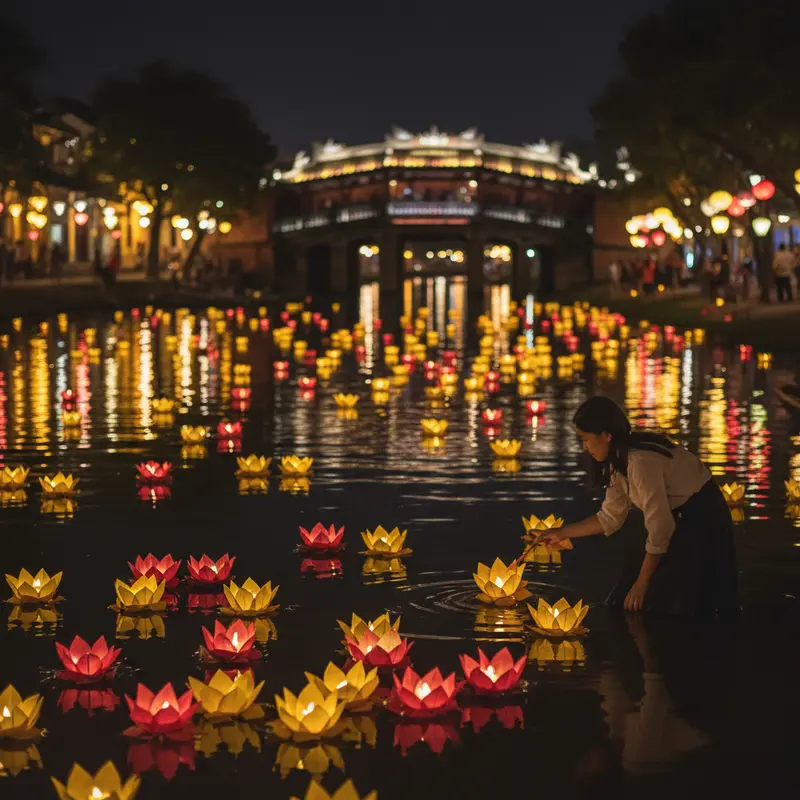
Release lanterns on the Hoai River: In the evening, lanterns are sold along the riverbank for about 10,000 – 24,000 VND (≈$1). Release a lantern into the river, watch the small flame drift away into the darkness — this is a moment that many people tell me is “the most beautiful part of their Hoi An trip.”
Cycle to Tra Que Vegetable Village: About 3 km from the ancient town, Tra Que Vegetable Village is where you can participate in growing vegetables with local farmers. In the early morning, the air is fresh, and the vegetable fields are lush green — a completely different experience from the hustle and bustle of the ancient town.
Estimated Costs for a Day Trip to Hoi An
Entrance Tickets and Other ExpensesFixed Pricing
Starting in 2023, the Hoi An Ancient Town Management Board has implemented a unified ticket system for the entire ancient town:
- Ancient Town Ticket: 144,000 VND (≈$6)/adult, 72,000 VND (≈$3)/child (ages 7-12). This ticket allows you to visit 5 sites from the designated heritage locations, including the Japanese Covered Bridge.
- Additional Tickets: If you wish to visit more sites, you can purchase additional tickets at a similar price.
[!WARNING] There are individuals selling counterfeit tickets or leading visitors to sites not on the official list to charge separate fees. Please only purchase tickets at the official ticket booths of the Hoi An Ancient Town Management Board (clearly marked in Vietnamese and English). Do not buy tickets from street vendors.
Reference Cost Table for One Day
| Item | Estimated Cost |
|---|---|
| Ancient Town Ticket | 144,000 VND (≈$6) |
Frequently Asked Questions
Frequently asked questions about Hoi An's Japanese Bridge
What is the best way to use this guide to Hoi An's Japanese Bridge: A 400-Year-Old Historical Icon?
Is Hoi An's Japanese Bridge: A 400-Year-Old Historical Icon suitable for a first-time visitor?
Can I combine Hoi An's Japanese Bridge: A 400-Year-Old Historical Icon with other nearby plans?
What should I confirm before making plans for Hoi An's Japanese Bridge: A 400-Year-Old Historical Icon?
How can I avoid last-minute problems with Hoi An's Japanese Bridge: A 400-Year-Old Historical Icon?
Tags
The Faifo Express
This article was written by the driver and travel consultant team at Faifo Express — over 5 years of experience in travel transport across Da Nang, Hoi An, and Hue. All information is based on real experience serving 5,000+ customers every month.
Related services
Airport Transfer
Hotel pickup, all-inclusive price
View DetailsDay Tour Car Rental
Ba Na Hills, Hoi An, My Son...
View DetailsShared Car
From just 100K VND/person
View DetailsTourist Car Rental
Explore the beauty of Central Vietnam with our private tourist car service.
View Details🛣️ Popular Routes
Follow Faifo Express
Get exclusive deals, real reviews and the latest Central Vietnam travel tips.
Faifo Express
Updates, customer reviews & real trip photos.
@trm.anh.travel
Real experience videos, Da Nang – Hoi An travel tips.
@xedichvudananghoianhue
Real videos of routes, fleet and transfer services.
@xedananghoianFE
Quick news, flash deals and direct interaction.
DM us on Facebook — response within 5 minutes