


Thien Mu Pagoda: The Seven-Story Landmark Watching Over the Perfume River
📋 Table of Contents
Thien Mu Pagoda – Standing Before the Phuoc Duyen Tower, I Understood Why Hue is Called the “Land of Spirituality”
There are places you visit once and can never forget. Thien Mu Pagoda is one of them.
I still remember the first early morning I stood on the banks of the Huong River, looking up at the seven-story Phuoc Duyen Tower majestically rising through the misty haze of Hue. The air was cool, the temple bell’s chime echoed from the hill, and the faint scent of incense drifted on the breeze – all creating a feeling I can only describe as “chillingly sacred.” This wasn’t the feeling of a tourist checking off a landmark, but the sensation of touching history, of touching the soul of an entire land.
Thien Mu Pagoda – the most sacred national pagoda of Hue, an indispensable symbol in any exploration of the ancient capital – is more than just a beautiful Buddhist architectural work. It is a place where history, spirituality, art, and nature blend in a way that no other pagoda in Vietnam can replicate. If you are planning a trip to Hue, this article will be your “living guide” to fully explore this over 400-year-old pagoda – from its lesser-known historical corners to the smartest ways to get there, unmissable experiences, and countless practical tips from someone who has visited many times.
What is Thien Mu Pagoda? A 400-Year History Full of Legends
The legend of the red-clad woman and the pagoda’s origin
In 1601, Lord Nguyen Hoang – the first lord of the Nguyen family in the South – during a tour along the Huong River, stopped at a small hill in Ha Khe village (now Huong Long ward, Hue City). Locals recounted that on every full moon night, an old woman in a red dress and green trousers would appear on the hill, sitting at its summit and saying: “Soon, a true lord will come to build a pagoda to gather spiritual energy, strengthen the dragon’s脉, and bring prosperity to our land.” After hearing this story, Lord Nguyen Hoang ordered a pagoda to be built on that very hill and named it Thien Mu – meaning “Heavenly Lady” or “Woman from Heaven.”
This is not just a beautiful legend. It reflects the philosophy of the people of Hue: every great undertaking must have a “heavenly mandate” – the witness of heaven and earth. And indeed, from its humble beginnings as a small temple, Thien Mu has become the national pagoda – the pagoda of the nation – continuously renovated, expanded, and elevated by successive Nguyen lords and kings.
Renovations and architecture through the dynasties
What few people know is that the pagoda you see today is not the original structure from 1601. Thien Mu Pagoda has undergone at least 7 major renovations under the reigns of lords and kings:
-
Lord Nguyen Phuc Chu (1710): This was the most significant renovation during the era of the Nguyen lords. Nguyen Phuc Chu had a great bell weighing over 2 tons cast (which still exists today), built many more structures, and invited Zen Master Thach Liem from China to reside there, transforming Thien Mu into the largest Buddhist center in the South.
-
King Thieu Tri (1844): He ordered the construction of the 7-story Phuoc Duyen Tower – the most iconic structure of the pagoda today – and the Huong Nguyen communal house. The tower was built over 3 years using bricklaying techniques without cement mortar, yet it has stood firm for over 170 years.
-
During the reign of Nguyen Phuc Khoat: He ordered the construction of four small towers to worship the Four Heavenly Kings at the four corners of the pagoda courtyard.
Each renovation marked the imprint of different dynasties on the pagoda, creating an architectural ensemble that is both unified and diverse – something that modern architects would find difficult to replicate.

The Special Historical and Political Role of Thien Mu
Not many pagodas in Vietnam have a history so intertwined with politics. Thien Mu is not just a place to worship Buddha; it was also where the Lords Nguyen and Emperors Nguyen came to pray before making any significant national decisions. During the resistance against the US, Thien Mu Pagoda was also the starting point of one of the world-shaking events: in 1963, Most Venerable Thich Quang Duc – the monk who self-immolated in Saigon to protest the Ngo Dinh Diem regime’s policy of oppressing Buddhism – used to study here. The green Austin Westminster car that carried him from Hue to Saigon that day is still displayed on the pagoda grounds. This is one of the most valuable historical artifacts that few tourists notice.
The Architecture of Thien Mu Pagoda – A Lesson in Harmony Between Humans and Nature
Phuoc Duyen Tower – An Irreplaceable Symbol
The Phuoc Duyen Tower is 21 meters high, with 7 octagonal floors, each floor housing a different Buddha. What’s special is that the tower was built entirely of fired bricks without steel reinforcement and without modern cement mortar, yet it has stood firm for over 170 years, enduring countless major storms and even wartime bombings.
Viewed from the Huong River, the Phuoc Duyen Tower appears like a lighthouse guiding the way to the ancient capital. This is precisely why it has become the representative image of Hue on every newspaper, tourist poster, and painting. But few people know that: inside the tower, there is a spiral staircase leading to the upper floors, although it is currently not open to visitors for conservation reasons. If you want to admire the panoramic view, head to the bank of the Huong River – that’s the most beautiful angle.
Overall Layout and Unmissable Structures
The grounds of Thien Mu Pagoda cover over 1 hectare, arranged along a straight axis from the Tam Quan gate to the main sanctuary. Following the main path, you will encounter:
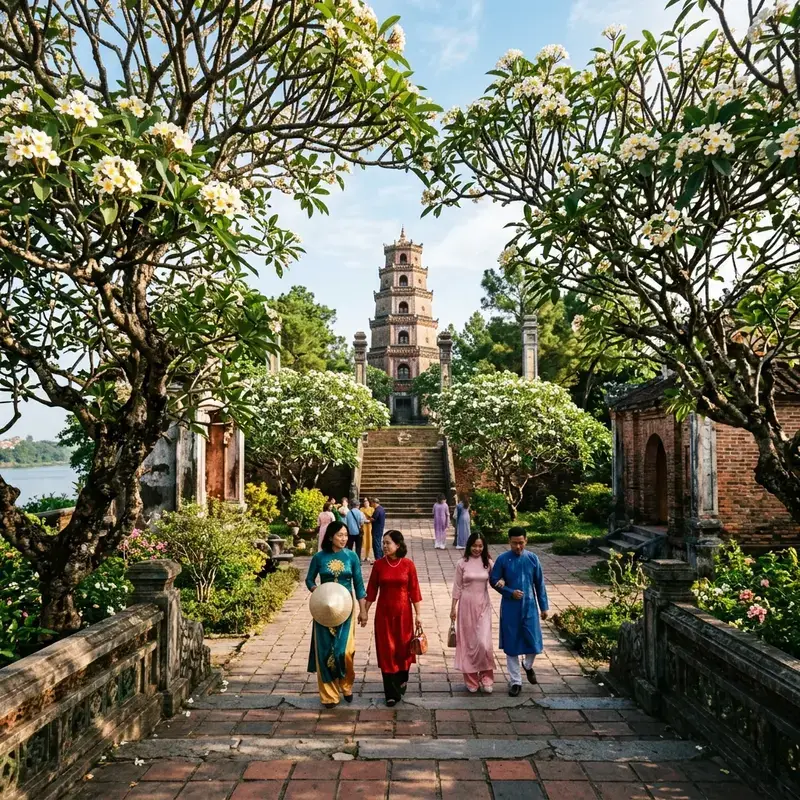
1. Tam Quan Gate and Front Courtyard: Two rows of ancient frangipani trees, white with blossoms in season (March-May), create a picturesque pathway. This is a favorite photo spot for many photographers.
2. Phuoc Duyen Tower: As described, this is the central highlight.
3. Huong Nguyen Pavilion (collapsed): Formerly opposite the Phuoc Duyen Tower, this pavilion collapsed due to lightning in 1904. The foundation remains and is being studied for restoration.
4. Dai Hung Palace: The main Buddha worship hall of the pagoda. Inside are exquisite black bronze statues of Maitreya Buddha and Shakyamuni Buddha, cast in the 17th-18th centuries.
5. Ksitigarbha and Avalokitesvara Palaces: Two smaller palaces on either side, dedicated to Bodhisattva Ksitigarbha and Bodhisattva Avalokitesvara. This is where local Buddhists most frequently come to pray.
6. Tower and Tomb Garden: Behind the pagoda is a quiet garden with the tomb towers of the successive abbots. Few tourists visit here, but this is my favorite spot – peaceful, ancient, and full of emotion.
7. Austin Car and Historical Artifacts Exhibition House: As mentioned, this is where the car associated with the Thich Quang Duc incident in 1963 is preserved.
Beauty That Changes with the Seasons – Thien Mu for Every Moment
This is something only those who have visited Thien Mu many times will realize: this pagoda is beautiful in different wayshau in each season.
- Spring (January-March): The frangipani trees haven’t bloomed yet, but the air is fresh and there are few tourists. In the early morning, a light mist covers the area, making the Phuoc Duyen Tower appear as mystical as a watercolor painting.
- Summer (April-June): Frangipani flowers bloom profusely, covering the pagoda courtyard in white. The brilliant golden sun highlights the red brick color of the tower. This is the most beautiful season for photography but also the hottest.
- Autumn (September-November): Golden leaves, cool air, and the late afternoon sun casting a golden hue on the tower create an indescribable classic beauty.
- Winter (December-February): The characteristic drizzle and fog of Hue create a mystical atmosphere, fitting for the pagoda’s meditative space.
Guide to Getting to Thien Mu Pagoda – Don’t Let Transportation Ruin Your Trip
Where is Thien Mu Pagoda?
Thien Mu Pagoda is located on Ha Khe Hill, Huong Long Ward, Hue City, about 5 km west of Hue city center (Dai Noi area) via Le Duan street along the northern bank of the Huong River.
From Da Nang to Hue – The Smartest Choice
If you are in Da Nang and want to visit Thien Mu Pagoda in Hue, the distance is about 100 km via Hai Van Pass – one of the most beautiful routes in Vietnam. This is where I want to be direct: don’t take a bus if you can afford it.
The reason is simple: a bus will drop you off at Phu Bai bus station or in Hue city center, and you’ll still have to find your own way to the pagoda. Not to mention, you’ll miss out on the entire beauty of Hai Van Pass – something many tourists regret later.
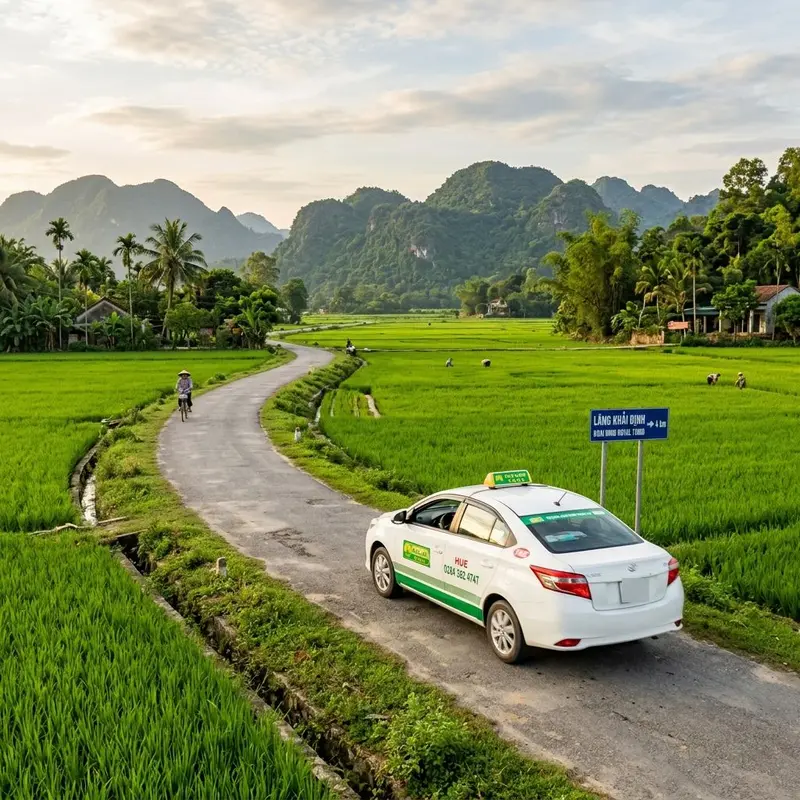
The solution I recommend: book a package transfer service from Faifo Express – a professional tourist car service run by locals, specializing in the Da Nang – Hue route and attractions around Hue. Faifo Express drivers are locals, knowledgeable about the roads, know beautiful stopping points on Hai Van Pass that you won’t find on Google Maps, and most importantly – fixed prices, Fair Prices, no detours. You can refer to Faifo Express’s Da Nang – Hue transfer service to start planning now.
[!TIP] If you are flying into Da Nang and want to go directly to Hue for the day, book Faifo Express’s airport transfer service in advance. The driver will pick you up right at the airport exit, no need to jostle for taxis or worry about being “ripped off” as many tourists have complained.
From Hue City Center to Thien Mu Pagoda
From the Dai Noi area or Hue Old Town, you can reach Thien Mu Pagoda in several ways:
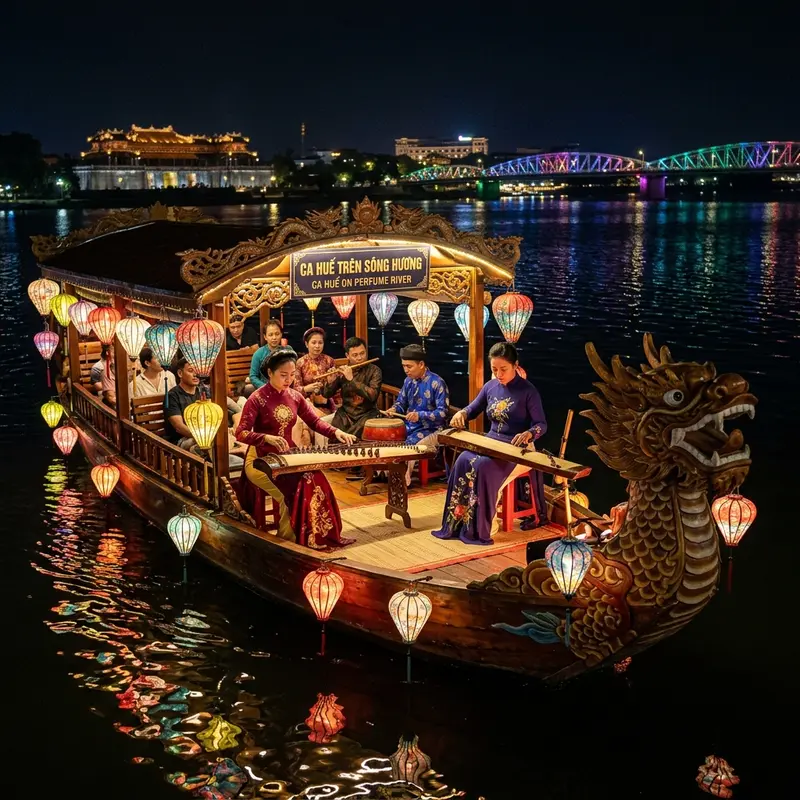
Option 1 – Boat trip on the Huong River (MOST RECOMMENDED): This is the most beautiful and authentic way to reach the pagoda. The pier is located on the bank of the Huong River, near Truong Tien Bridge. A traditional dragon boat will take you down the Huong River for about 30-45 minutes, allowing you to admire the scenery on both banks before docking at the foot of Ha Khe Hill. Boat rental prices range from 150,000 – 300,000 VND (≈$12)/person depending on the boat and time.
Option 2 – Bicycle: Hue is an ideal city for cycling. From the center, you can rent a bicycle (about 50,000-96,000 VND (≈$4)/day) and cycle along the Huong River for about 30-40 minutes. The riverside road is extremely beautiful and flat.
Option 3 – Motorbike or Electric Car: If you rent a motorbike, follow Le Duan or Kim Long street for about 15-20 minutes. Hue also currently has tourist electric cars running on inner-city routes, which are quite convenient.
Option 4 – Taxi/Grab: Convenient but I don’t recommend it because drivers often “take detours” to increase the fare. If you use it, be sure to turn on the meter or agree on the price beforehand.
[!WARNING] Avoid people offering “cheap Huong River boat tours” in the Dai Noi area or Dong Ba Market. In many cases, tourists have been led to dilapidated boats., the boatman was unlicensed, and the price was inflated midway. It’s best to book a boat through your hotel or reputable tour operators.

Experiencing Thien Mu Pagoda – How to Make the Most of Your Visit?
Things You MUST Do at Thien Mu Pagoda
1. Arrive Early for a Private Experience
Thien Mu Pagoda is open from 7 AM to 5:30 PM. If you arrive before 8 AM, you’ll have almost the entire complex to yourself. The early morning atmosphere at the pagoda is exceptionally serene: the echoing of bells, the scent of incense, the chirping of birds in the garden – all contribute to a natural meditative experience without any effort.
2. Listen to the Great Bell
The Great Bell of Thien Mu Pagoda weighs over 2 tons and was cast in 1710, making it one of the largest ancient bells in Vietnam. Its chime can be heard for kilometers. If you’re lucky, you’ll hear the bell in the early morning or late afternoon – a sound that locals in Hue call “the call of heaven and earth.”
3. Spend Time in the Rear Mausoleum Garden
This is the least-known area among tourists. The mausoleum garden, with its moss-covered stone stupas and ancient trees providing shade, offers absolute tranquility – this is where you can truly “feel” Thien Mu instead of just taking photos.
4. See the Historical Artifact – The Austin Westminster Car
Don’t forget to visit the exhibition hall to the right of the main shrine. The green Austin Westminster car that transported Venerable Thich Quang Duc to Saigon in 1963 is a globally significant historical artifact, attracting many international historians for research.
5. The Best Photo Spots You Might Not Know About
- Spot 1: Looking up from the bank of the Huong River – this is the most classic angle, especially beautiful at dawn when the mist is still lingering.
- Spot 2: Standing at the foot of the tower and looking up vertically – creates an impressive perspective effect.
- Spot 3: The frangipani pathway – if you visit during the right season (April-June), this is the most “viral” photo spot.
- Spot 4: The back courtyard looking out to the garden – the late afternoon light filtering through the leaves creates a beautiful natural bokeh effect.
What to Eat Near Thien Mu Pagoda?
There aren’t many eateries right around the pagoda, but along Kim Long street leading to it, there are some worthwhile dining options:
-
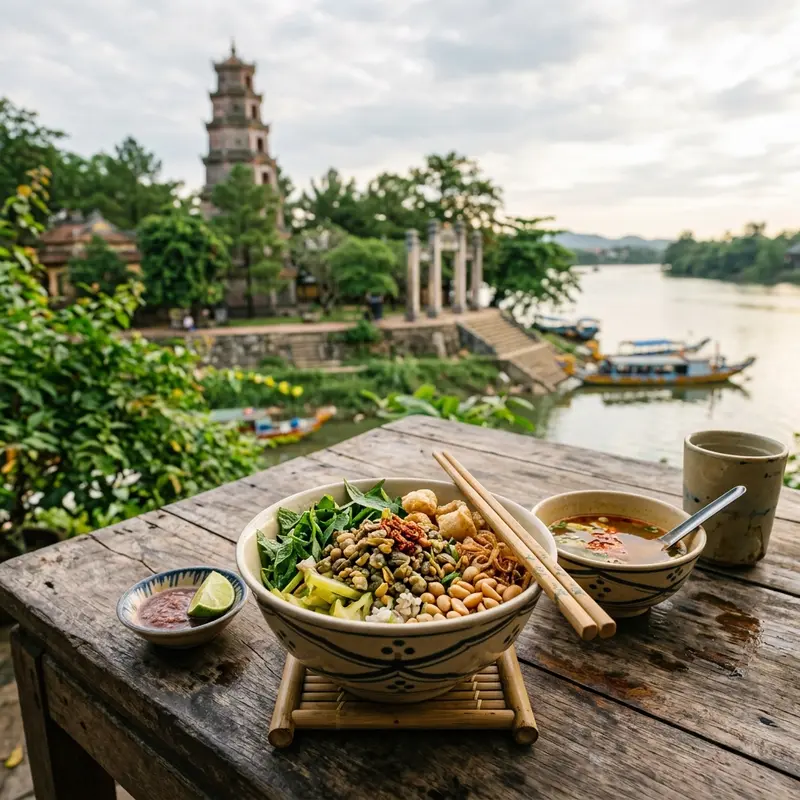
Banh Canh Nam Pho: A Hue specialty less known outside the local area. This noodle soup features thick noodles and a rich broth made from shrimp and crab, served with crab cakes. The price is around 25,000-42,000 VND (≈$2) per bowl.
-
Com Hen Kim Long: Com Hen (rice with clams) is a signature Hue breakfast dish. The Kim Long area has many delicious Com Hen stalls, with prices as low as 15,000-30,000 VND (≈$1) per bowl.
-
Hue Sweet Soups by the Roadside: After visiting the pagoda, stop by a roadside stall to enjoy sweet soups like “che bot loc boc thit quay” (tapioca dumplings with grilled pork), “che dau ngu” (royal bean sweet soup), or “che hat sen” (lotus seed sweet soup) – these are characteristic royal court desserts of Hue.
[!NOTE] If you want to have breakfast before entering the pagoda, head to Kim Long Market, about 1 km from the pagoda. This is a local morning market with all sorts of authentic Hue snacks at cheap prices, not catering to tourists, so you won’t be overpriced.
Estimated Costs for Visiting Thien Mu Pagoda
This is a section many travel blogs often skip or write about vaguely. I will list the details so you can create an accurate budget:
Entrance FeeThien Mu Pagoda currently offers FREE admission. This is a difference compared to many other attractions in Hue. However, if you purchase a combo ticket for Hue’s historical sites (Imperial City, tombs, etc.), Thien Mu Pagoda is not included in that combo – you can visit it completely freely.
Transportation Costs
[!NOTE] Pricing Note for International Tourists The prices listed are inclusive of a 20% tax and service fee applied to foreign tourists. Estimated USD rates are based on current exchange rates and may slightly vary.
| Means of Transport | Estimated Cost |
|---|---|
| Dragon boat from Hue city center | 150,000 – 300,000 VND (≈$12)/person |
| Bicycle rental (full day) | 50,000 – 96,000 VND (≈$4) |
| Motorbike rental (full day) | 120,000 – 216,000 VND (≈$8) |
| Taxi/Grab from city center | 80,000 – 144,000 VND (≈$6)/one-way |
| Shuttle bus Da Nang – Hue (Faifo Express) | Contact for the best price |
Food Costs in the Area
| Dish | Price |
|---|---|
| Com hen (clam rice) | 15,000 – 30,000 VND (≈$1) |
| Banh canh Nam Pho | 25,000 – 42,000 VND (≈$2) |
| Bun bo Hue | 35,000 – 60,000 VND (≈$2) |
| Che Hue (Hue sweet soup) | 18,000 VND (≈$1) |
Frequently Asked Questions
Frequently asked questions about Thien Mu Pagoda
What is the best way to use this guide to Thien Mu Pagoda: Sacred National Pagoda & Hue Symbol?
Is Thien Mu Pagoda: Sacred National Pagoda & Hue Symbol suitable for a first-time visitor?
Can I combine Thien Mu Pagoda: Sacred National Pagoda & Hue Symbol with other nearby plans?
What should I confirm before making plans for Thien Mu Pagoda: Sacred National Pagoda & Hue Symbol?
How can I avoid last-minute problems with Thien Mu Pagoda: Sacred National Pagoda & Hue Symbol?
Tags
The Faifo Express
This article was written by the driver and travel consultant team at Faifo Express — over 5 years of experience in travel transport across Da Nang, Hoi An, and Hue. All information is based on real experience serving 5,000+ customers every month.
Related services
Airport Transfer
Hotel pickup, all-inclusive price
View DetailsDay Tour Car Rental
Ba Na Hills, Hoi An, My Son...
View DetailsShared Car
From just 100K VND/person
View DetailsTourist Car Rental
Explore the beauty of Central Vietnam with our private tourist car service.
View Details🛣️ Popular Routes
Follow Faifo Express
Get exclusive deals, real reviews and the latest Central Vietnam travel tips.
Faifo Express
Updates, customer reviews & real trip photos.
@trm.anh.travel
Real experience videos, Da Nang – Hoi An travel tips.
@xedichvudananghoianhue
Real videos of routes, fleet and transfer services.
@xedananghoianFE
Quick news, flash deals and direct interaction.
DM us on Facebook — response within 5 minutes