


An Evening of Ca Hue Music, Drifting Down the Perfume River
📋 Table of Contents
When the Perfume River Sings — Emotions You Can’t Find Anywhere Else
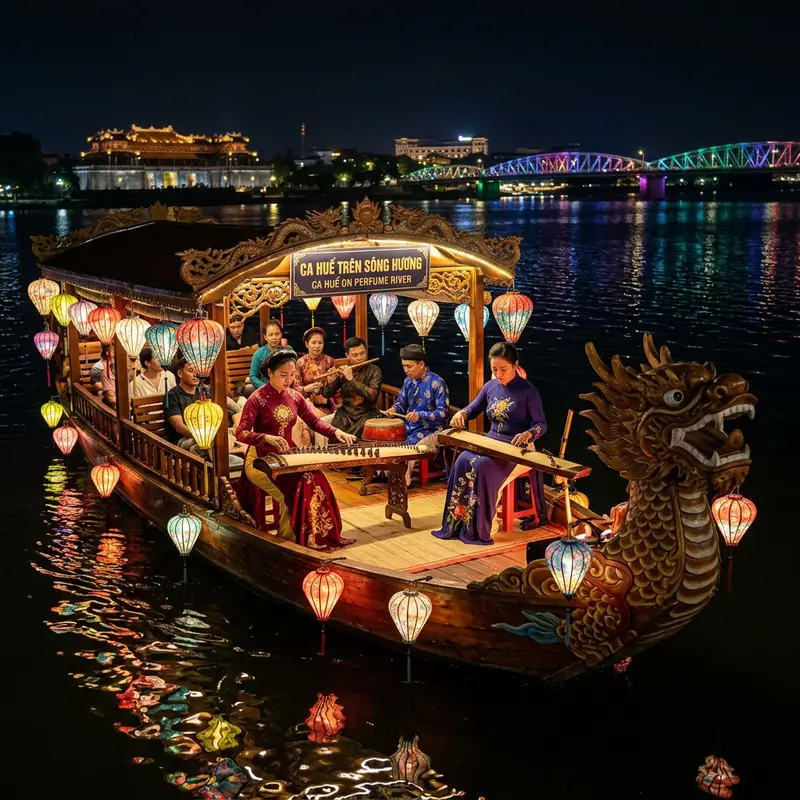
There are evenings, when the dragon boat gently glides on the Perfume River, the shimmering lantern light reflects on the water’s surface like a thousand stars falling to earth — I suddenly understood why Hue people say, “you haven’t truly been to Hue until you’ve heard Ca Hue on the Perfume River.” It’s not an exaggeration. It’s a truth distilled through hundreds of years of history, through every rise and fall of the dan tranh, dan bau, and the singing voice echoing between the vast sky and water. Listening to Ca Hue on the Perfume River is not merely an entertainment activity — it is a cultural ritual, a journey back to the soul of the ancient capital. If you are planning your trip to Hue and want a truly different, profound, and lifelong memorable experience, then this article is the “map” you need.
What is Ca Hue? Understanding It to Love It Properly
Origins and Historical Formation
Ca Hue is a chamber music genre characteristic of the ancient Thuan Hoa — Phu Xuan region, which formed and developed strongly during the period when the Nguyen Lords moved south to establish their territory from the 17th century. It is a delicate fusion of solemn court music and the simple folk music of the people of Hue — a rare blend that creates a genre that is both noble and intimate.
During the time of the Nguyen Lords and later the Nguyen Dynasty, Ca Hue was nurtured in the royal court, becoming a form of entertainment for the aristocracy and officials. But unlike Nha Nhac (royal court music), which was solemn and ceremonial, Ca Hue possessed greater emotional depth, containing the sentiments of the people — romantic love, longing for one’s homeland, contemplation of life’s principles. Because of this, Ca Hue gradually “descended to the streets,” weaving into the lives of the people and becoming a living heritage of the community.
In 2015, Ca Hue was included in the National Intangible Cultural Heritage List of Vietnam. This is not just administrative recognition — it is proof of the enduring vitality of an art form that has stood firm through countless historical ups and downs.
Musical Characteristics — What Makes Ca Hue Different?
If you have ever listened to Quan Ho Bac Ninh or Don Ca Tai Tu Nam Bo, you will immediately recognize that Ca Hue has a completely unique “color.” Hue people say Ca Hue has two opposing yet coexisting personalities: “Dieu Bac” (lively, cheerful) and “Dieu Nam” (sad, mournful, contemplative). The transition between these two modes within a performance creates an indescribable emotional depth — you might laugh and then feel like crying within the span of an hour.
The ensemble in Ca Hue typically includes:
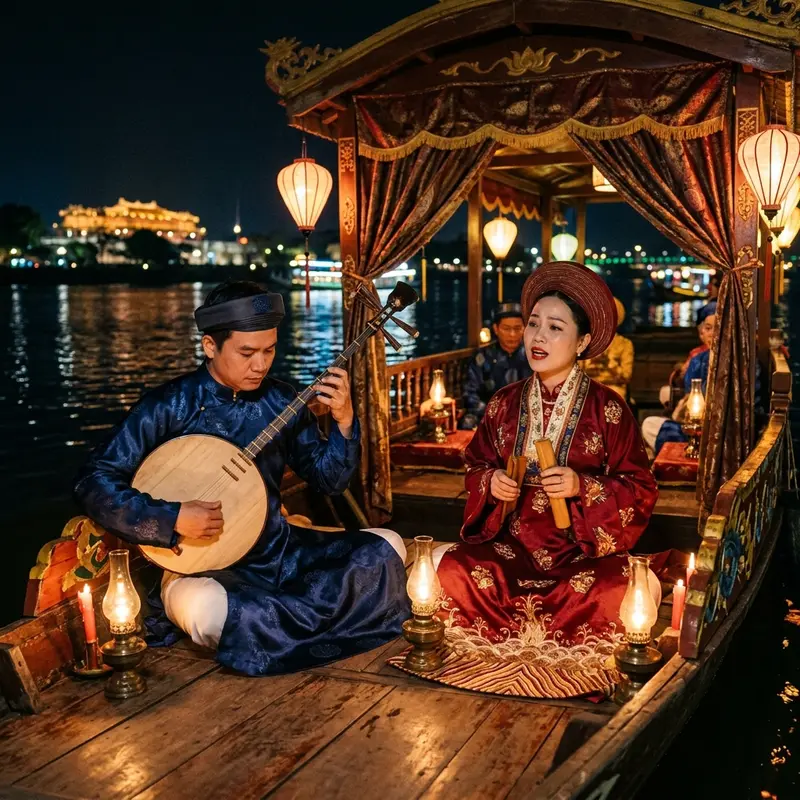
- Dan Tranh (also known as Dan Thap Luc): Its clear, melodious sound is the “voice” of Ca Hue.
- Dan Bau: Its resonant, poignant sound can imitate the sound of weeping.
- Dan Nguyet: Its warm, rustic sound.
- Dan Ty Ba: Its rich sound with diverse nuances.
- Dan Nhi: Its sound is closest to the human voice.
- Bamboo Flute and Xiao: Adding the colors of the wind and nature.
- Drums and Clappers: Maintaining the rhythm, providing the foundation for the entire ensemble.
What always fascinates me every time I listen to Ca Hue is how the artists improvise — they don’t just play music from a rigid score but also “converse” with each other, with nature, with the emotions of that particular night. Each performance is a unique creation, never to be repeated.Classic Hue Folk Songs You’ll Get to Hear
During a Hue folk song performance on the Huong River, you’ll typically enjoy about 8-12 songs, depending on the program’s duration. Some indispensable classic songs include:
- Nam Ai: The most sorrowful and mournful tune, often opening or closing the performance.
- Nam Binh: Gentle and profound, often associated with the imagery of the Huong River and Ngu Mountain.
- Tu Dai Canh: A long, solemn song describing the four beautiful scenes of heaven and earth.
- Long Ngam: The majestic sound of a dragon’s roar.
- Hanh Van: A rhythm like clouds drifting, free and unrestrained.
- Ly Tinh Tang: Joyful and witty, a typical Northern tune.
[!TIP] Before attending a Hue folk song performance, listen to a few songs on YouTube to familiarize yourself with the sounds. Once you have a “trained ear,” you’ll appreciate the subtlety of each song and enjoy it much more deeply. Searching for “Nam Ai ca Hue” or “Nam Binh ca Hue” is a good starting point.
Real Experience: What’s a Night of Hue Folk Songs on the Huong River Like?
From the Wharf to the Middle of the River — The Journey Begins
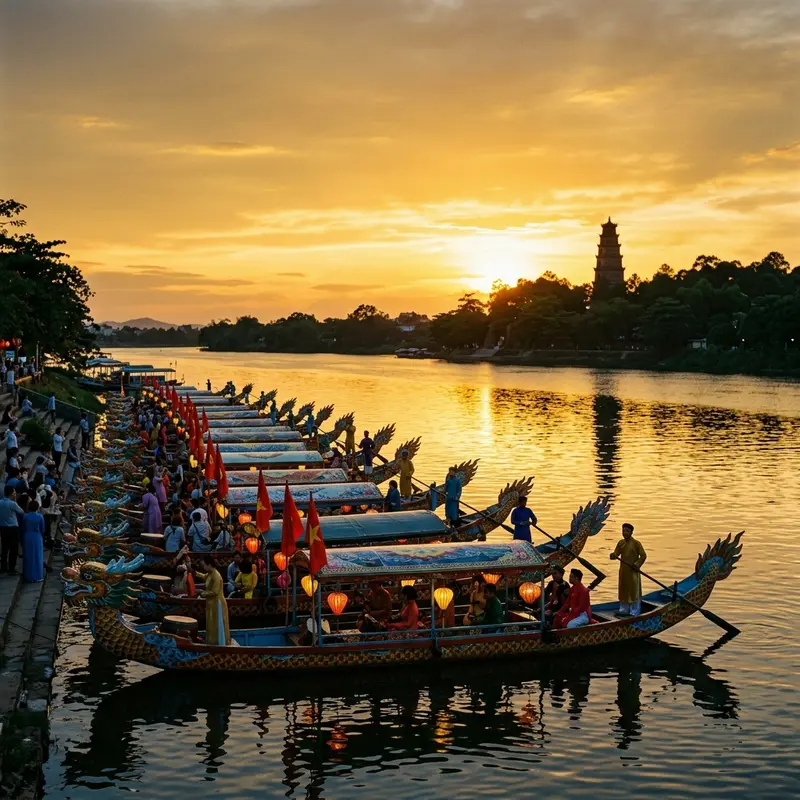
Most Hue folk song tours on the Huong River depart from Toa Kham Wharf (near Truong Tien Bridge) or Dong Ba Wharf. The gathering time is usually around 7:30 PM - 8:00 PM, as darkness begins to fall and the first lights start to twinkle on the river.
Stepping onto a dragon boat — boats gilded and decorated with royal patterns — you’ll immediately feel like you’re entering another realm. Not the 21st century with smartphones and social media, but the ancient realm of Hue, of moonlit nights when kings and queens enjoyed music by the Huong River.
The boat gently leaves the wharf. The sound of oars stirring the water. And then — the sound of the dan tranh begins.
The Performance Space on the Boat
Hue folk song boats typically accommodate 20-40 people, depending on their size. The space is elaborately decorated: the floor is covered with floral mats, lanterns hang overhead, and low tables are set with tea and cakes. The musicians and singers are seated at the front of the boat, facing the audience.
What I want to tell you directly — and this is an “insight” from someone who has been many times — is that the quality of the experience depends heavily on the organizing unit you choose. Some boats have only 3-4 amateur musicians who perform perfunctorily. But there are also boats with truly well-trained artisans, some of whom have performed for decades and have been awarded titles by the state. Choosing the right boat is the deciding factor.
[!NOTE] The Center for the Preservation of Hue Ancient Citadel Monuments has a list of officially licensed Hue folk song organizers. Prioritize these units over buying tickets from street vendors — the quality and safety will be much better assured.
Interacting with the Artists — Something Few Do, But Is Very Worthwhile
This is a secret I want to share: don’t just listen passively. Hue folk song artists are usually very happy to be asked about the songs, the instruments, or their lives as artists. During the intermission, approach them and ask questions — you’ll hear stories that aren’t in any textbook.
Once, a 70-year-old dan tranh artist told me she learned to play at the age of 7 from her father, who was the last court musician of the Nguyen Dynasty. She said: “Hue folk song is the voice of the heart of the fisherman”Listen to Hue. Each song is a life.” That saying made me understand Hue folk songs in a completely different way.
Some organizers even allow guests to try playing musical instruments after the performance — this is an extremely precious opportunity, don’t miss it!
Guide to Getting to Hue and the Perfume River Boat Landing
From Da Nang to Hue — The Smartest Choice
If you are in Da Nang and want to go to Hue to listen to Hue folk songs on the Perfume River, the distance is only about 100km, but it is one of the most beautiful routes in Vietnam — the majestic Hai Van Pass, the poetic Lang Co beach, and rolling mountains.
Many tourists think of taxis or Grab, but in reality, this is not the optimal choice for many reasons: the cost is not fixed, drivers are not always knowledgeable about the local area, and most importantly, safety on Hai Van Pass — this route requires real driving experience.
The option I always recommend to friends and readers is to use the service of Faifo Express- a professional tourist transport company with a team of local drivers who know every curve of Hai Van Pass. What I particularly like about Faifo Express is the all-inclusive shuttle service, no extra costs, and drivers are willing to share interesting stops along the way — from scenic viewpoints on the pass to delicious local eateries that only locals know.
[!TIP] If you fly into Da Nang and want to go directly to Hue, Faifo Express’s Da Nang Airport Shuttle Service can pick you up right at the airport exit and take you straight to the Perfume River boat landing — saving maximum time and effort. No need to worry about luggage or changing vehicles midway.
From Hoi An to Hue
If you are in Hoi An — a charming ancient town about 30km from Da Nang — the journey to Hue is also very convenient. Faifo Express’s Hoi An to Hue Car Service is a choice trusted by many international tourists, with modern 4-7 seater cars, cool air conditioning, and drivers who can speak basic English.
I often suggest this itinerary to friends: depart from Hoi An in the morning, stop at Hai Van Pass for 30 minutes for photos and sightseeing, have lunch in Lang Co, arrive in Hue around 2 PM - 3 PM — enough time to visit the Imperial City or the tombs in the afternoon, and then go to the boat landing in the evening to listen to Hue folk songs. A perfect day!
Getting Around Hue City
Once you arrive in Hue, the Toa Kham boat landing is right in the city center, very easy to find. From most hotels on Le Loi, Hung Vuong streets, or the area around Trang Tien Bridge, you can walk to the boat landing within 5-15 minutes.
[!WARNING] Avoid unbranded motorbike taxis or unofficial taxis at night in the boat landing area. Some cases have reported customers being overpriced. If you need transportation, use the Grab app or book a car through your hotel.
Estimated Costs — How Much for a Memorable Night?
Ticket Prices for Listening to Hue Folk Songs
This is the information most people ask about, and I’ll be direct so you don’t get “ripped off”:
[!NOTE] Pricing Note for International Tourists The prices listed are inclusive of a 20% tax and service fee applied to foreign tourists. Estimated USD rates are based on current exchange rates and may slightly vary.
| Ticket Type | Popular Price | Notes |
|---|---|---|
| Basic Ticket (boat + music) | 100,000 - 180,000 VND (≈$7)/person | Does not include food and drinks |
| Combo Ticket (boat + music + tea/cake) | 200,000 - 300,000 VND (≈$12)/person | Most popular |
| VIP Ticket (private boat for groups) | 1,500,000 - 3,600,000 VND (≈$138)/boat | Renting a whole boat, suitable for groups of 10-20 people |
| Ticket with dinner on the boat | 350,000 - 600,000 VND (≈$23)/person |
[!WARNING] Be cautious of street vendors at the wharf offering “super cheap” tickets for 50,000-84,000 VND (≈$3). In reality, these are often tickets for low-quality boats, unprofessional musicians, or even counterfeit tickets. Purchase tickets at the official counter or book in advance through reputable travel agencies.
Transportation Costs
- Da Nang - Hue (Private car Faifo Express): Approximately 700,000 - 1,080,000 VND (≈$42)/4-seater car (one-way), very economical for groups of 3-4 people
- Hoi An - Hue (Private car Faifo Express): Approximately 900,000 - 1,320,000 VND (≈$51)/4-seater car
- Grab/taxi within Hue: 30,000 - 96,000 VND (≈$4) depending on the distance
Food and Drink Costs After the Music Performance
After an emotional night of Hue folk singing, you’ll want to savor authentic Hue cuisine. The areas around the wharf and Trinh Cong Son street (along the river) have many delicious eateries:
- Bun bo Hue at sidewalk stalls: 35,000 - 66,000 VND (≈$3)/bowl
- Banh khoai on Le Loi street: 50,000 - 96,000 VND (≈$4)/piece
- Com hen in the early morning (if you stay overnight): 20,000 - 36,000 VND (≈$1)/bowl
- Riverside restaurant dinner: 200,000 - 480,000 VND (≈$18)/person
Practical Experience — Secrets Only Locals Know
When is the Best Time to Go?
Hue folk singing on the Huong River takes place year-round, but each season offers a unique charm:
Spring (February-April): This is the ideal time. The weather is cool, flamboyant flowers begin to bloom, and the post-Tet atmosphere is still filled with tranquility. The Huong River is clear and calm during this season.
Summer (May-August): It’s hot, but the evenings are beautiful. The breeze from the river is refreshing. This is also the peak tourist season, so boats are often crowded — book your tickets at least 2-3 days in advance.
Hue Festival (April-May, even-numbered years): If you’re lucky enough to visit during the Hue Festival, the folk singing on the Huong River will be performed on a much grander scale with top artists from across the country. This is a peak experience.
Rainy Season (September-November): Hue experiences heavy rain, sometimes with storms. Some tours may be canceled due to weather. However, listening to Hue folk singing amidst the patter of rain on the boat roof has its own melancholic, romantic beauty.
[!TIP] The golden hour to arrive at the wharf is 7:30 PM - 8:00 PM. Don’t be late as boats usually depart on time. If you arrive earlier, you can stroll along the Huong River bank and watch the sunset — one of Hue’s unmissable sights.
Appropriate Attire
This is something many tourists overlook but is actually important. Hue folk singing is an elegant art form, and the dragon boat setting is highly cultural — your attire should also be appropriate for the setting.
Recommended: Ao dai (if you have one, it’s extremely suitable and you’ll get beautiful photos), polite and light clothing, comfortable but not overly casual outfits.
Not recommended: Short shorts, tank tops, flip-flops — not because they are forbidden, but because you will feel out of place and your photos won’t look good.
Practical note: Evenings on the river can be quite cold in winter (November-February), especially when the wind blows. Bring a light scarf or a light jacket.
Best Check-in and Photo Spots
As a travel blogger, I can’t skip this:
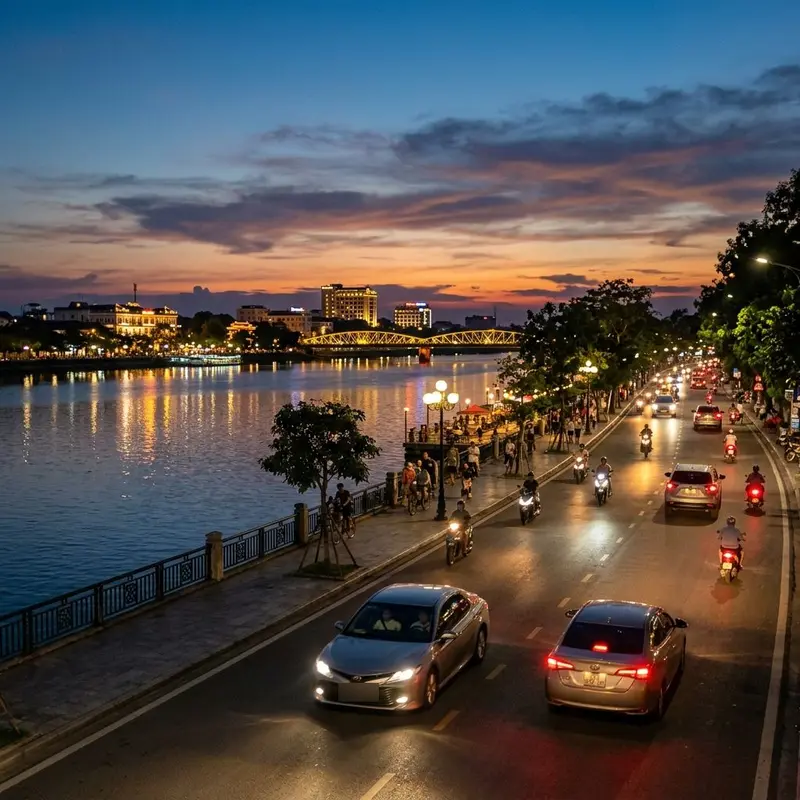
- Photo spot of the boats from Truong Tien Bridge: Standing on the bridge and looking down, the brightly lit dragon boats with lanterns on the dark river create a magical scene. Shoot around 8 PM - 9 PM when it’s fully dark.
- Photo spot on the boat: Sit at the bow of the boat, facing backward, capturing the entire orchestra and lantern lights. Use portrait mode with a high ISO.
- Photo spot of theReflection**: When the boat stops in the middle of the river, the calm water reflects the lights — this is the golden moment for the most shimmering photos.
- Photoshoot in Ao Dai: Many Ao Dai rental places are located near the pier, costing around 100,000-180,000 VND (≈$7) for 2 hours.
[!NOTE] When photographing artisans, ask for permission first and avoid using strong flash — flash photography can innovate performances and is disrespectful to the artisans.
Insider Tips for Best Value
I’ll be direct about these because I’ve seen many tourists get ripped off:
1. Cheap ticket touts: As mentioned, stay away.
Frequently Asked Questions
Frequently asked questions about Hue Folk Songs
What is the best way to use this guide to Hue Folk Songs: Cultural Experience on Perfume River?
Is Hue Folk Songs: Cultural Experience on Perfume River suitable for a first-time visitor?
Can I combine Hue Folk Songs: Cultural Experience on Perfume River with other nearby plans?
What should I confirm before making plans for Hue Folk Songs: Cultural Experience on Perfume River?
How can I avoid last-minute problems with Hue Folk Songs: Cultural Experience on Perfume River?
Tags
The Faifo Express
This article was written by the driver and travel consultant team at Faifo Express — over 5 years of experience in travel transport across Da Nang, Hoi An, and Hue. All information is based on real experience serving 5,000+ customers every month.
Related services
Airport Transfer
Hotel pickup, all-inclusive price
View DetailsDay Tour Car Rental
Ba Na Hills, Hoi An, My Son...
View DetailsShared Car
From just 100K VND/person
View DetailsTourist Car Rental
Explore the beauty of Central Vietnam with our private tourist car service.
View Details🛣️ Popular Routes


Follow Faifo Express
Get exclusive deals, real reviews and the latest Central Vietnam travel tips.
Faifo Express
Updates, customer reviews & real trip photos.
@trm.anh.travel
Real experience videos, Da Nang – Hoi An travel tips.
@xedichvudananghoianhue
Real videos of routes, fleet and transfer services.
@xedananghoianFE
Quick news, flash deals and direct interaction.
DM us on Facebook — response within 5 minutes